Fabric Scraps Obsession, Studio

Scrappy Experimentations

Check out Schnauzer Snips for Sassy the Schnauzer’s latest musings

This post is follow to my previous post A Scrappy Existence:

In 2012, thanks to my friend Betty Anne, I expanded my love of fabric scraps from cotton quilting fabric scraps to silk and linen garment scraps. If you check out the Gallery you will see examples of quilts made solely from silk and linen scraps from garment construction.

Recently I have expanded to experimenting with creating pieces from denim and wool scraps.

I have collected denim scraps for a couple years from old jeans in anticipation of a future ‘upcycling’ project. In early 2013 Betty Anne shared her stash of men’s wool suiting scraps and Pendleton wool scraps and samples given to her by a  friend. My first experiment with these scraps was making wool pincushions as gifts for fellow attendees at a quilt retreat last year. I was nervous to expanded working with wool scraps beyond making pin cushions.

It took until early 2014 to get the courage to create a piece/art quilt/wall hanging using the wool scraps. I combined them with denim scraps to create a piece I named ‘He Dresses Up, He Dresses Down’. The center of the quilt is constructed from wool suiting scraps (He Dresses Up) which have a luxurious texture. The center is framed on each side with a combination of Pendleton wool scraps and denim scraps (He Dresses Down…slang for comfortable, casual dress).
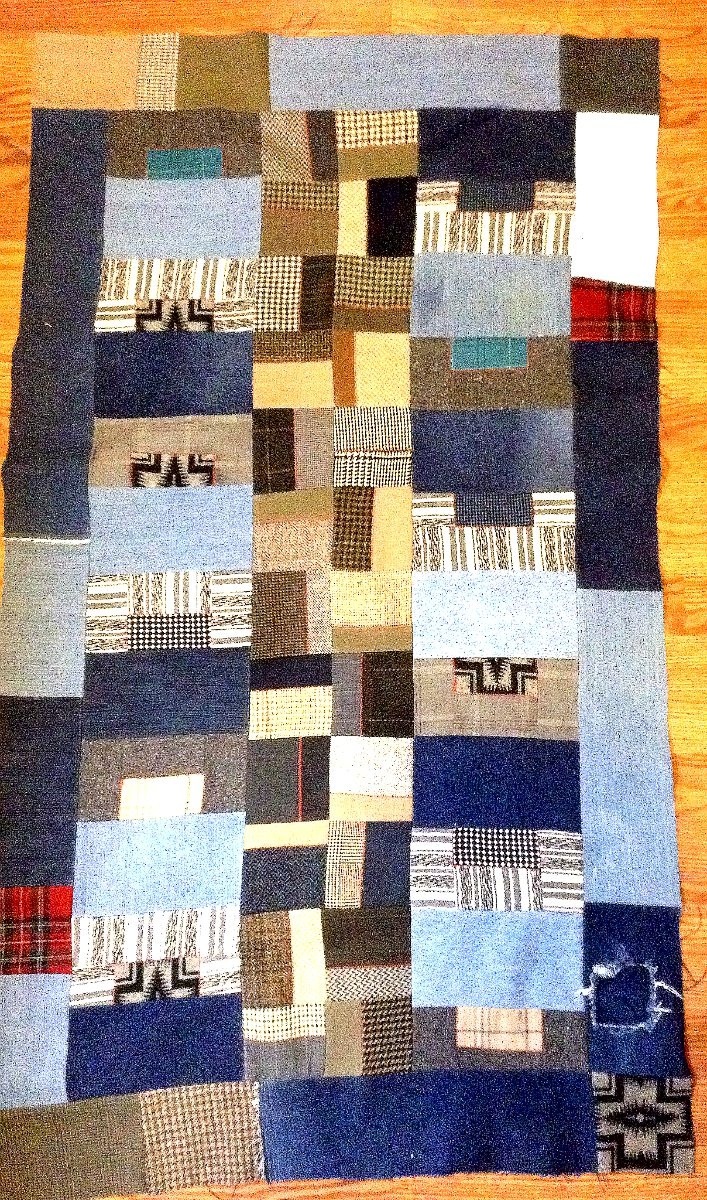
'He Dresses Up, He Dresses Down', designed & pieced by Tierney Hogan, 2014
‘He Dresses Up, He Dresses Down’, designed & pieced by Tierney Hogan, 2014

Piecing wool scraps can be a bit challenging. The seams between wool scraps are bulky when wool pieces are sewn together. Instead of pressing seams to one side as you would normally do with cotton fabric quilt construction, you have to press the seams open AND anchor them down to reduce the bulk. I used a red thread zig zag stitch (for contrast) on the front of wool pieced sections to anchor the seams and reduce the bulk.

The quilt is currently awaiting long-arm quilting and I will post the completed piece to the Gallery.

Now – what category of fabric scraps to experiment with next? Probably upholstery scraps – my friend Cindy gave me a box of upholstery samples. I have seen cool bags made from upholstery fabric – I am thinking either a functional item (like a purse/bag) or a wall hanging. Upholstery fabric scraps would not not make for a cozy quilt!

So imagine me in a white lab coat, with crazy-mad-scientist-hair, beakers of fabric scraps in hand, ready to the next wild experiment!
Fabric Scraps Obsession, tierneycreates

A Scrappy Existence

Okay. I love fabric scraps. I am not sure how or when it started but it has been going on for years. And it has developed into an obsession.

I go to a quilting class or a quilt retreat and I see piles of fabric scraps, many which are going to be thrown away.  I have been guilty of staying a little late after a quilting class to “clean up” and grab the fabric scraps left behind – on the class ironing board, on the table, under the table…okay once I reached into the trash during a quilting class (when no one was looking) to rescue a large beautiful discarded scrap!

A local quilt shop sells bags of high quality scraps and I have bought several over the years. There is something exciting about a new bag of scraps – the discovery – opening up the bag and seeing what goodies are inside! When visiting friends in Seattle during an annual quilting trip, we stop by a quilt shop that allows customers to fill up a sandwich bag (yes the small one) with scraps for $3. I see it as the “challenge of the century” each time. I have mastered rolling up scraps tightly and cramming them into the tiny bag. My friends are usually amazed when I empty the bag later and see how many fabric scraps I fit in!

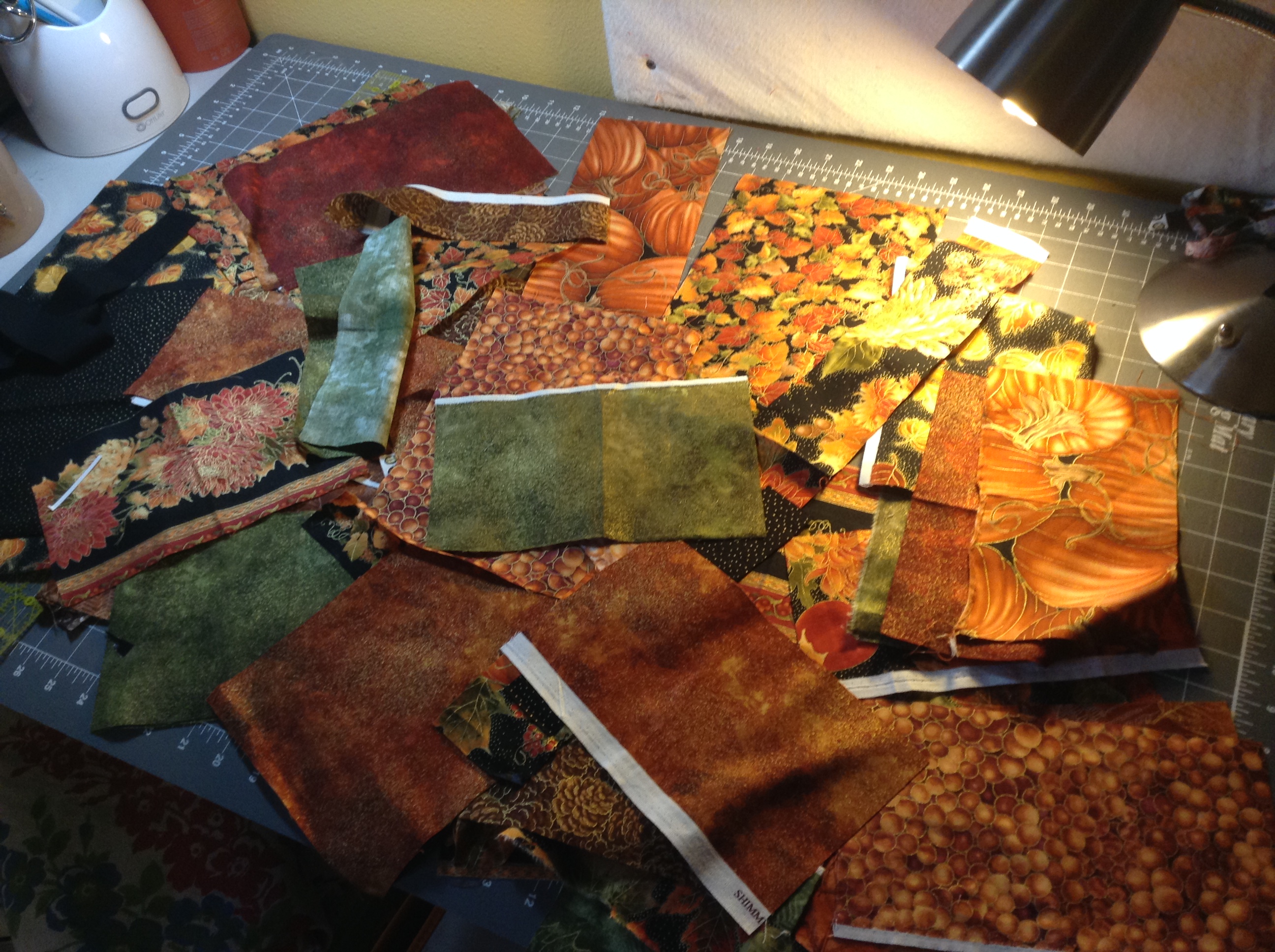
My quilting friends support my fabric scrap obsession. A dear friend and original quilting mentor, Judy, sent me over the holidays a lovely package of scraps from a recent quilt she finished.

Yummy fall color scraps from my friend Judy

I do make quilts with the scraps, though my husband says it will take roughly 25 quilts to use up my scraps.

Today I pondered: “why do I love fabric scraps so much?” The high quality quilting fabric scraps that I am attracted are from quilts others make. I guess that using other quilters’ scraps in a quilt (or just having them in my quilt room!) connects me to other quilters and the quilts they make. Quilts are pretty special thing and I love thinking that my fabric scraps are part of handmade items making someone, somewhere smile.

Textiles & Smiles!

Studio

The End(s) Is Near!

Please see the Textile Adventures page for info on my new line of Flannel Yum-Yum Quilts!

The final step to completing a quilt, whether you have quilted it yourself or sent it out to be professionally long-arm quilted, is to put on the binding. The challenge with binding is that you need to make it long enough (but not too long) to go around your entire quilt and allow for you to properly pivot the binding in the four corners of the quilt.

Quilt bindings (for the non quilters reading) are traditionally made from folded in half 2 1/4 or 2 1/2 inch strips of fabric  that coordinate with the quilt. The the binding is sewn to the edge of the quilt with a 1/4 inch seam. Then it is time to put on a movie, plop down in your favorite chair with needle and thread and hand sew down the other edge of the binding to the back of the quilt.

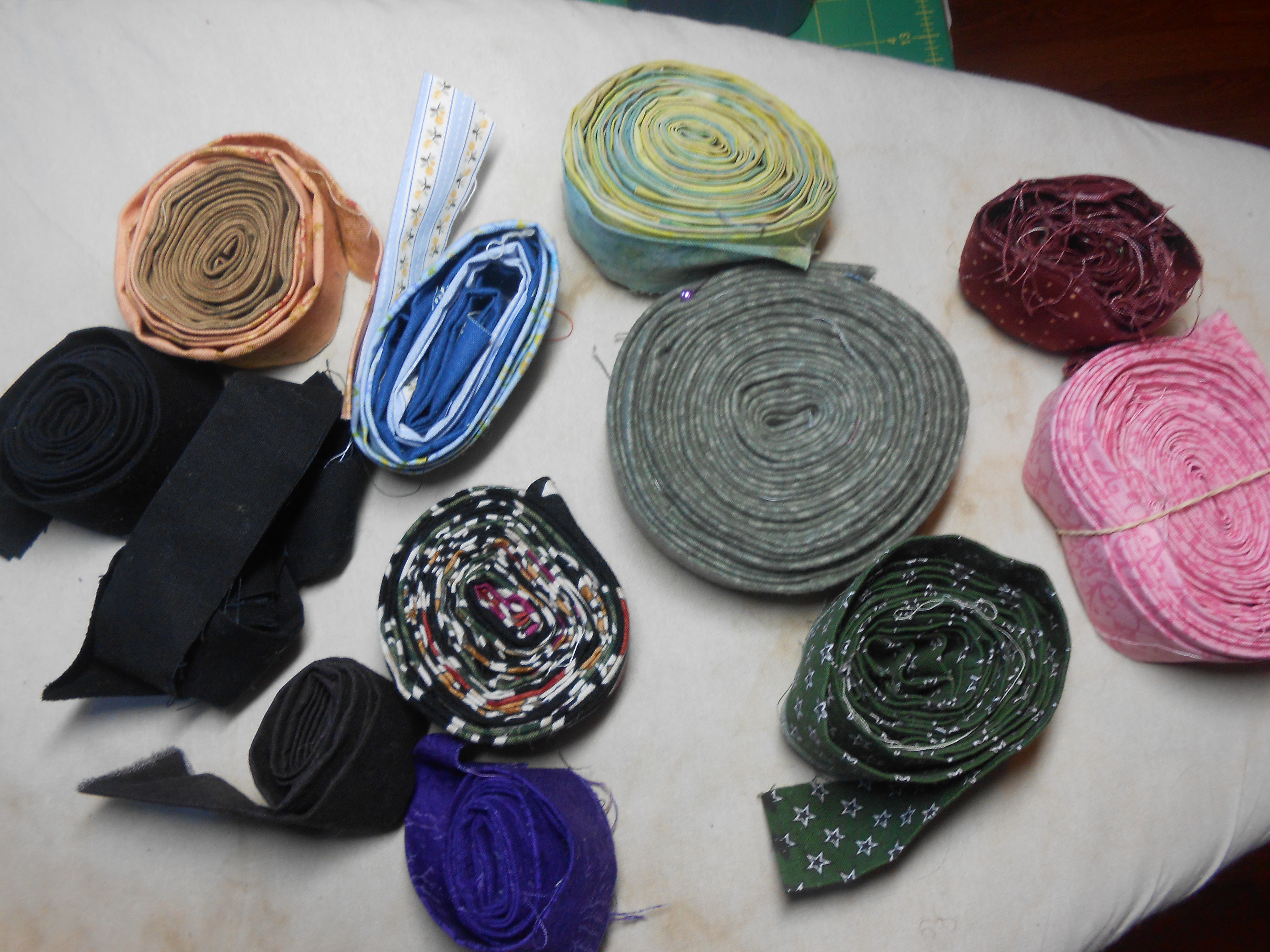
My collection of quilt bindings ENDS

If you are a quilter you know of the challenges of sewing enough strips together (but not too many, ha!) for your binding. If you are like me, then you always have extra binding left over!  Occasionally (ok frequently) I have shocking lengths of binding leftover. It is like I was planning to go around the quilt TWICE with the binding!

I could never bring myself to just put the leftover binding back in my fabric scrap stash, so I came up with the idea of saving any leftover quilt binding ENDS to use on small quilts, potholders, wall hangings, etc.  I have also pieced together binding ends from previous quilts to make a scrappy binding for my current quilt. I love using the ends – “waste not, want not”!

Always keep your ENDS near!