Fabric Scraps Obsession, Studio

“Log Jamming”: The Sequel

This is a followup to my post What’s on the Design Wall: “Log Jamming” :

Last Tuesday evening I took the Log Jam Class at the Stitchin’ Post quilt shop, this time with the actual instructor, Jackie. Jackie is the Queen of the Log Jam (and a wonderful and fun instructor) and I picked up a couple tips I missed when my friends and I made our own class up earlier this year (when our instructor had to cancel so my friends taught me how to “log jam” as discussed in the post What’s on the Design Wall: “Log Jamming” ).

Taking the class again (well taking it for real with the official instructor), got me even more addicted to log jamming. I also learned that the log jamming technique is based on an old African sewing process. I thought it was something the quilt shop had developed, I did not realize it had so much history. Log jamming is such a great way to work through your fabric scrap collection!

So far I have completed 56 – 6 1/2 inch log jam blocks and I have another 30 some in progress. Not sure when I am going to stop working on the blocks and make them into something. Maybe I will just create a huge pile of log jam blocks enough for a couple King-size quilts. But, alas, that will still not put a dent in my fabric scrap collection

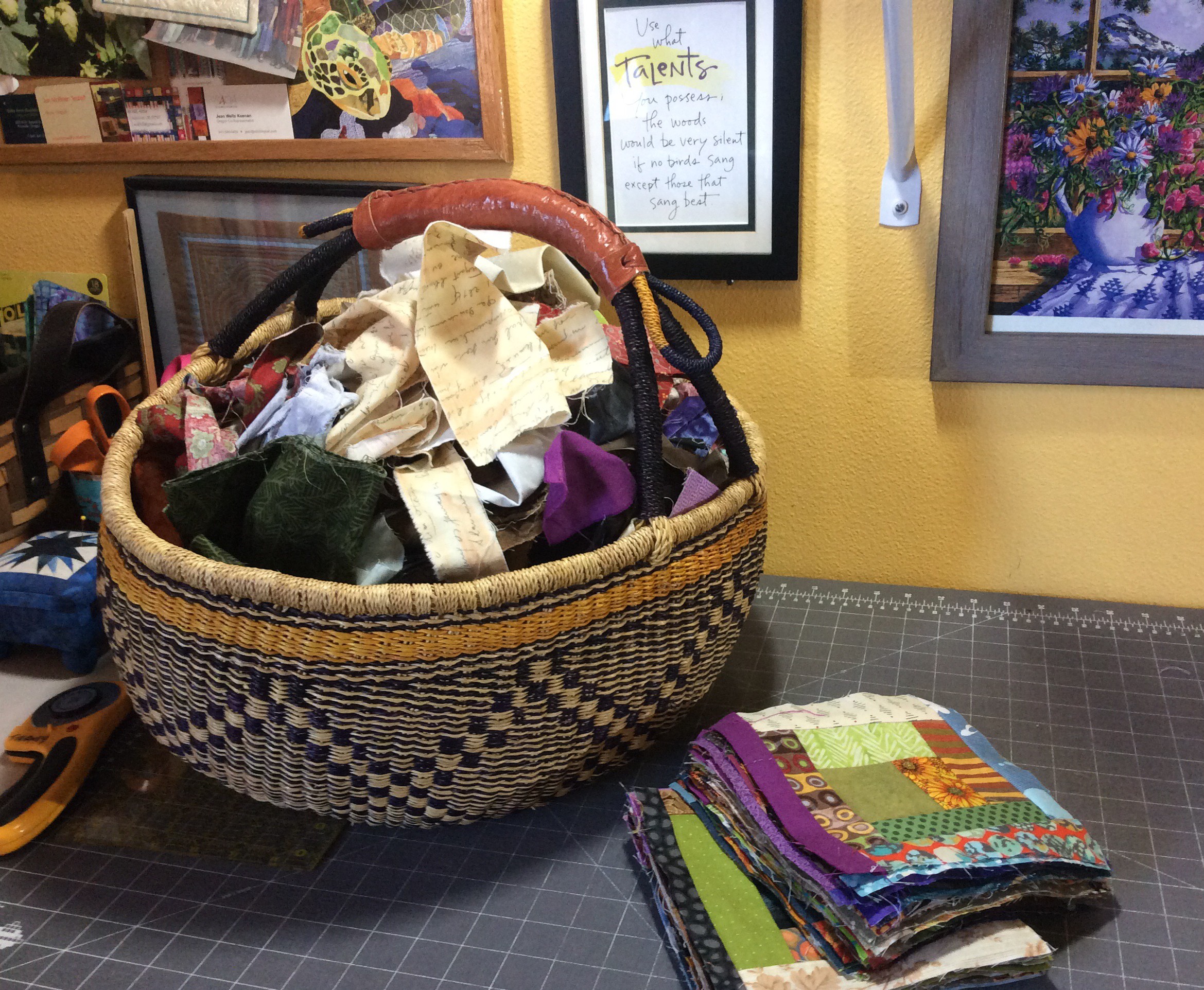
Below is a photo of the basket of coordinating scraps I use while log jamming and my current stack of blocks. My plan is to keep  log jamming with this palette until I exhaust this palette of scraps (or I become exhausted from using the same palette!)
IMG_0378
Basket of scraps for log jamming and stack of completed blocks
Studio, What's on the Design Wall

What Was On the Design Wall: Rescued Blocks

Usually I post about what’s on the design wall – what I am currently working on. I was looking through some digital photos and came across photos from when I was working on the 1930’s Block Quilt, made from rescued blocks. So this is sort of a “design wall retrospective” post!

I am fascinated with recycling fabric, especially fabric intended for other purposes (clothing, blankets, upholstery, etc.). I also enjoy finding abandoned blocks and rescuing them!

What are “abandoned blocks”? They are quilt blocks leftover from making a quilt (when too many blocks were made than needed), or when a quilt was started but not finished and the quilter just gave up on the blocks. You can rescue sets of abandoned blocks from thrift stores, friends, and even inside your own stash! Betty Anne had a friend who found a set of block from the 1930s in her attic and did not want them. Betty Anne rescued them and then let me adopt them!

Originally these rescued blocks did not fit together and were in a strange pattern (so strange that no matter what I did I could not make them fit together). So I redesigned the blocks, cutting off the left and right corners (which I recycled into the quilt’s border). After trimming down the blocks they fit well together into a small lap size quilt (41″ x 44 1/2″).

The abandon blocks are now rescued and part of a quilt (I bet they are a lot happier than they would be just sitting around an attic all alone!)

Fabric Scraps Obsession, Studio, What's on the Design Wall

What’s on the Design Wall: “Log Jamming”

A couple of weeks ago I was scheduled to take a quilting class called “Log Jam“. Log Jam is an innovative way to rapidly create scrappy log cabin quilt blocks. If you are a new quilter or not a quilter, a “log cabin” block is a quilting block made by starting with a small center square and building consistent standardly sized strips of fabric around the center square. The log jam concept throws the requirement of consistency sized strips out the window. “Log jamming” makes the log cabin style quilt block construction process laid back, casual, scrappy and fun! When making a log jam quilt you can use a specific palette of scraps, solid colors, or random scraps to make the piece very scrappy.

Unfortunately only three people registered for the class (myself and two of my friends) and it this did not meet the threshold to hold the class. The quilt shop was so wonderful and let us use their classroom anyway and hold our own class (two of my friends had taken the class before). So we spent 6 hours having a blast “log jamming“. The “log jam” method involves the kind of quilt block making you can do while chatting and giggling with friends – it is fun and less structured. We ended up being very silly and singing songs while we were working on our log jams. I even modified Bob Marley’s song “Jamming” to “Log Jamming”!

Now the 27 blocks I made log jamming are sitting on my design wall. I am trying to decide what I want to do with these blocks: maybe a table runner for my series of my Modern Quilt Table Runners on my Etsy shop or maybe one quilt with the blocks set into a solid background or floated. Every quilter should find space for a design wall – it helps to lay your pieces out to see where you want to take them!

If you live in the Central Oregon area, the Stitchin’ Post has a wonderful Log Jam class that my friends and I highly recommend you take!

Fabric Scraps Obsession, Studio

Scrappy Experimentations

Check out Schnauzer Snips for Sassy the Schnauzer’s latest musings

This post is follow to my previous post A Scrappy Existence:

In 2012, thanks to my friend Betty Anne, I expanded my love of fabric scraps from cotton quilting fabric scraps to silk and linen garment scraps. If you check out the Gallery you will see examples of quilts made solely from silk and linen scraps from garment construction.

Recently I have expanded to experimenting with creating pieces from denim and wool scraps.

I have collected denim scraps for a couple years from old jeans in anticipation of a future ‘upcycling’ project. In early 2013 Betty Anne shared her stash of men’s wool suiting scraps and Pendleton wool scraps and samples given to her by a  friend. My first experiment with these scraps was making wool pincushions as gifts for fellow attendees at a quilt retreat last year. I was nervous to expanded working with wool scraps beyond making pin cushions.

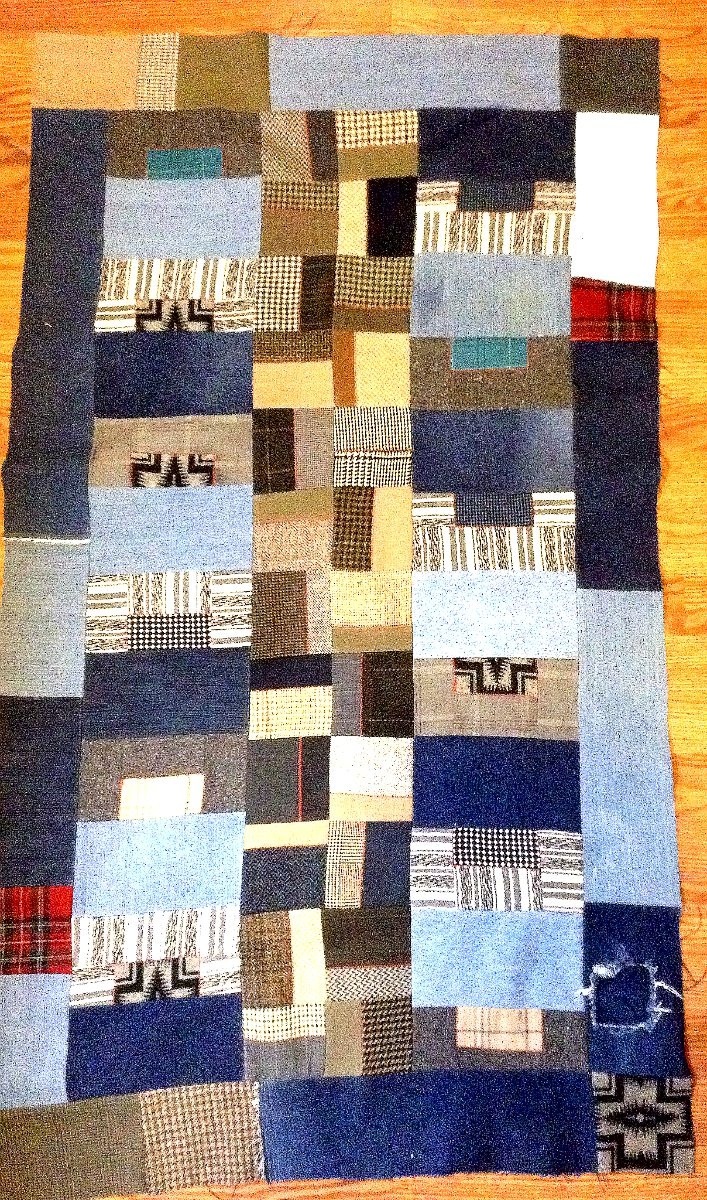
It took until early 2014 to get the courage to create a piece/art quilt/wall hanging using the wool scraps. I combined them with denim scraps to create a piece I named ‘He Dresses Up, He Dresses Down’. The center of the quilt is constructed from wool suiting scraps (He Dresses Up) which have a luxurious texture. The center is framed on each side with a combination of Pendleton wool scraps and denim scraps (He Dresses Down…slang for comfortable, casual dress).

'He Dresses Up, He Dresses Down', designed & pieced by Tierney Hogan, 2014
‘He Dresses Up, He Dresses Down’, designed & pieced by Tierney Hogan, 2014

Piecing wool scraps can be a bit challenging. The seams between wool scraps are bulky when wool pieces are sewn together. Instead of pressing seams to one side as you would normally do with cotton fabric quilt construction, you have to press the seams open AND anchor them down to reduce the bulk. I used a red thread zig zag stitch (for contrast) on the front of wool pieced sections to anchor the seams and reduce the bulk.

The quilt is currently awaiting long-arm quilting and I will post the completed piece to the Gallery.

Now – what category of fabric scraps to experiment with next? Probably upholstery scraps – my friend Cindy gave me a box of upholstery samples. I have seen cool bags made from upholstery fabric – I am thinking either a functional item (like a purse/bag) or a wall hanging. Upholstery fabric scraps would not not make for a cozy quilt!

So imagine me in a white lab coat, with crazy-mad-scientist-hair, beakers of fabric scraps in hand, ready to the next wild experiment!

Fabric Scraps Obsession, tierneycreates

A Scrappy Existence

Okay. I love fabric scraps. I am not sure how or when it started but it has been going on for years. And it has developed into an obsession.

I go to a quilting class or a quilt retreat and I see piles of fabric scraps, many which are going to be thrown away.  I have been guilty of staying a little late after a quilting class to “clean up” and grab the fabric scraps left behind – on the class ironing board, on the table, under the table…okay once I reached into the trash during a quilting class (when no one was looking) to rescue a large beautiful discarded scrap!

A local quilt shop sells bags of high quality scraps and I have bought several over the years. There is something exciting about a new bag of scraps – the discovery – opening up the bag and seeing what goodies are inside! When visiting friends in Seattle during an annual quilting trip, we stop by a quilt shop that allows customers to fill up a sandwich bag (yes the small one) with scraps for $3. I see it as the “challenge of the century” each time. I have mastered rolling up scraps tightly and cramming them into the tiny bag. My friends are usually amazed when I empty the bag later and see how many fabric scraps I fit in!

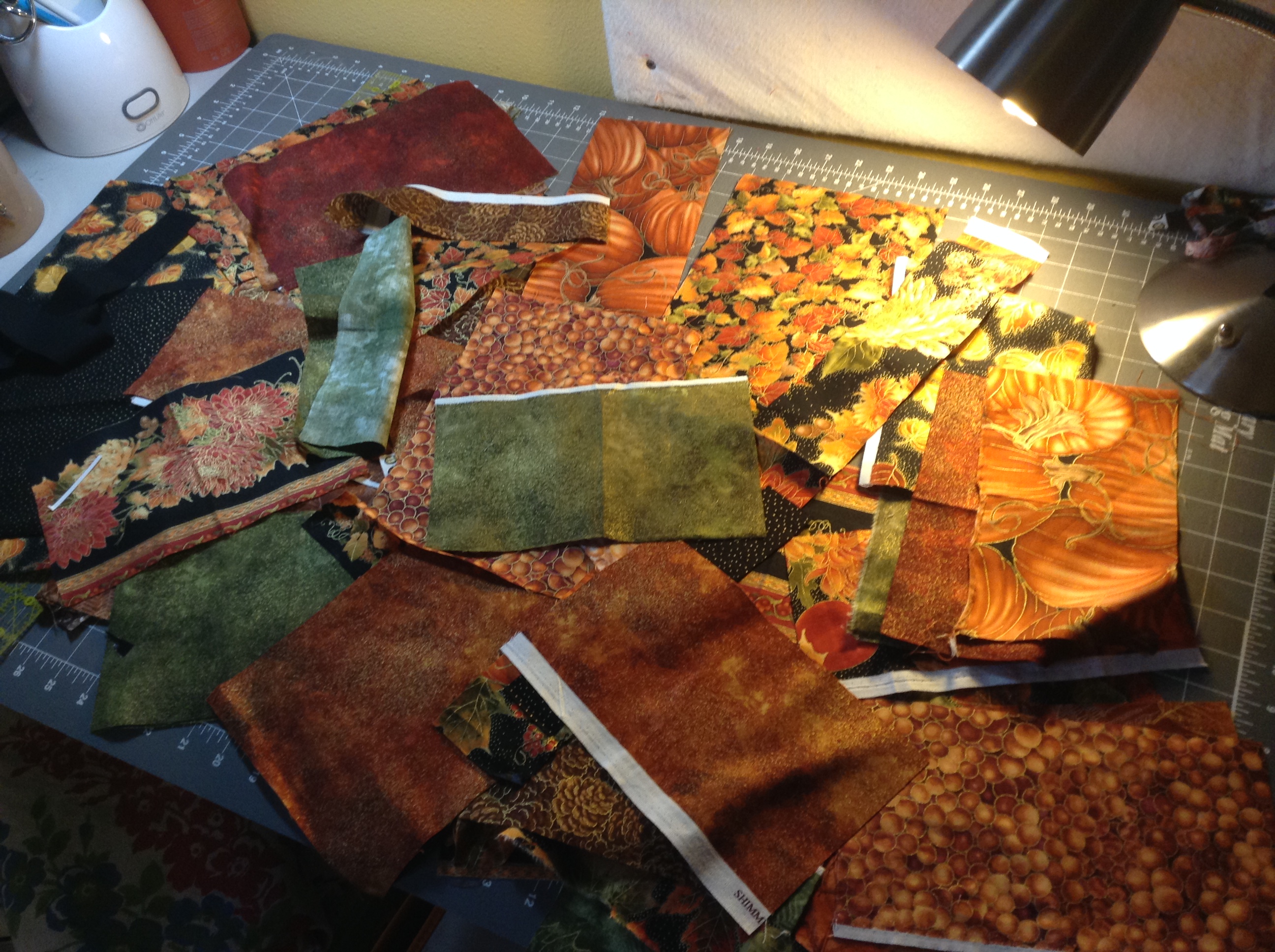
My quilting friends support my fabric scrap obsession. A dear friend and original quilting mentor, Judy, sent me over the holidays a lovely package of scraps from a recent quilt she finished.

Yummy fall color scraps from my friend Judy

I do make quilts with the scraps, though my husband says it will take roughly 25 quilts to use up my scraps.

Today I pondered: “why do I love fabric scraps so much?” The high quality quilting fabric scraps that I am attracted are from quilts others make. I guess that using other quilters’ scraps in a quilt (or just having them in my quilt room!) connects me to other quilters and the quilts they make. Quilts are pretty special thing and I love thinking that my fabric scraps are part of handmade items making someone, somewhere smile.

Textiles & Smiles!