As I mentioned in that post, when making freeform (I think this is what I am going to call them from now on) log cabin blocks, you might want to mock up (or actually sew) one completed block to verify that you like where you are going with you design.
I did this with one of the 42 (well actually 43 – I made a spare one) freeform log cabin blocks I made from my pile of brown, gold and orange scraps:
I decided that I needed something to break up the gold, I did not want to place all the gold framed squares side by side, so I decided to try floating the blocks in a taupe Peppered Cotton.
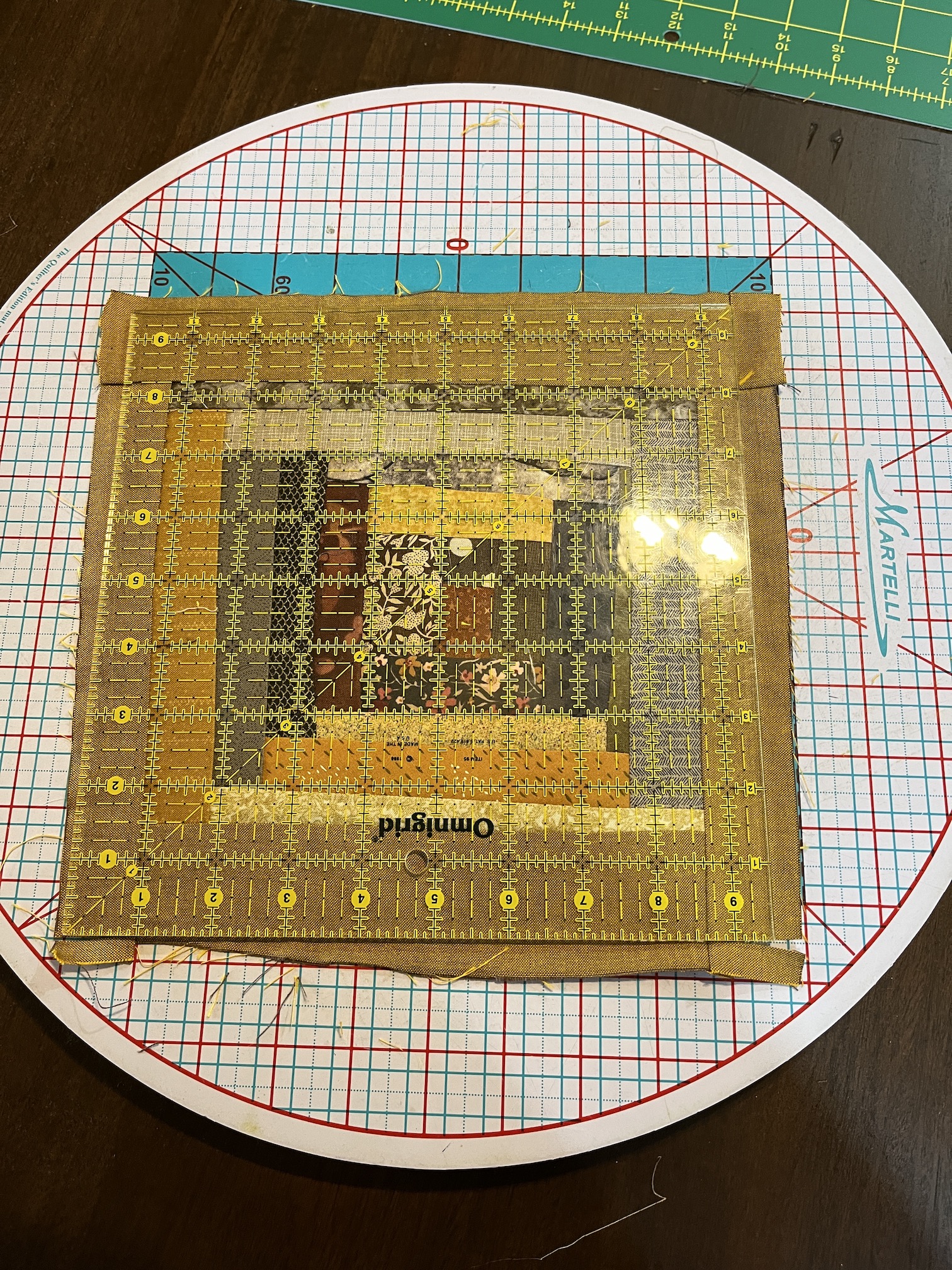
I’d originally trimmed the freeform log cabin block trimmed in gold Peppered Cotton and trimmed the block to 9.5 x 9.5 inches with my 9.5 x 9.5 inch square ruler. Then I tried framing it in the taupe and trimming it to 12.5 x 12.5 inches using my ruler of that size (the next size up ruler I own after 9.5 x 9.5 inch).
(By the way, I highly recommend some type of rotating cutting surface if you are trimming your freeform log cabin blocks to a uniform size with a square ruler – I have the Martelli Round Cutting Mat).
I realized a problem after I made the demo block: I have 42 blocks and my plan was to make a quilt for my home library for snuggling under while reading that is 6 blocks by 7 blocks.
At 12.5 x 12.5 inches each (12 x 12 inches finished) it would become a bed size quilt…oh no – let me try some fake math – the quilt would end up around 72 inches by 84 inches…actually larger if I added a little border around the quilt to make the blocks “float”.
I did revisit just sewing the gold framed blocks together and it does not make a large enough snuggle quilt. You might be thinking: what about just adding more of the gold fabric on the edges of the quilt as a border to “float” the blocks? Well I’ve run out of the gold fabric! I have less than a 1/4 yard left.
I was pondering my quandary when John asked about latticing instead of floating each block in the taupe – to use the taupe as a “lattice” instead. So I tried it out:
I like it! The taupe quiets the gold and it will all go nicely with the colors in my home library.
(The quilt currently on the loveseat and two little matching pillows, from orphan blocks, I plan to sell on my Etsy shop someday as they are not really my style and I want someone else to enjoy them.)
So that is where I am at in my design process.
Here are the 42 completed 9.5 x 9.5 inch blocks awaiting their lattice:
I realized didn’t share very many photos or details about the scrappy improvisational log cabin blocks I made at the Scrap Happy Quilt Retreat (link to all the posts related to this 5 day retreat) last week.
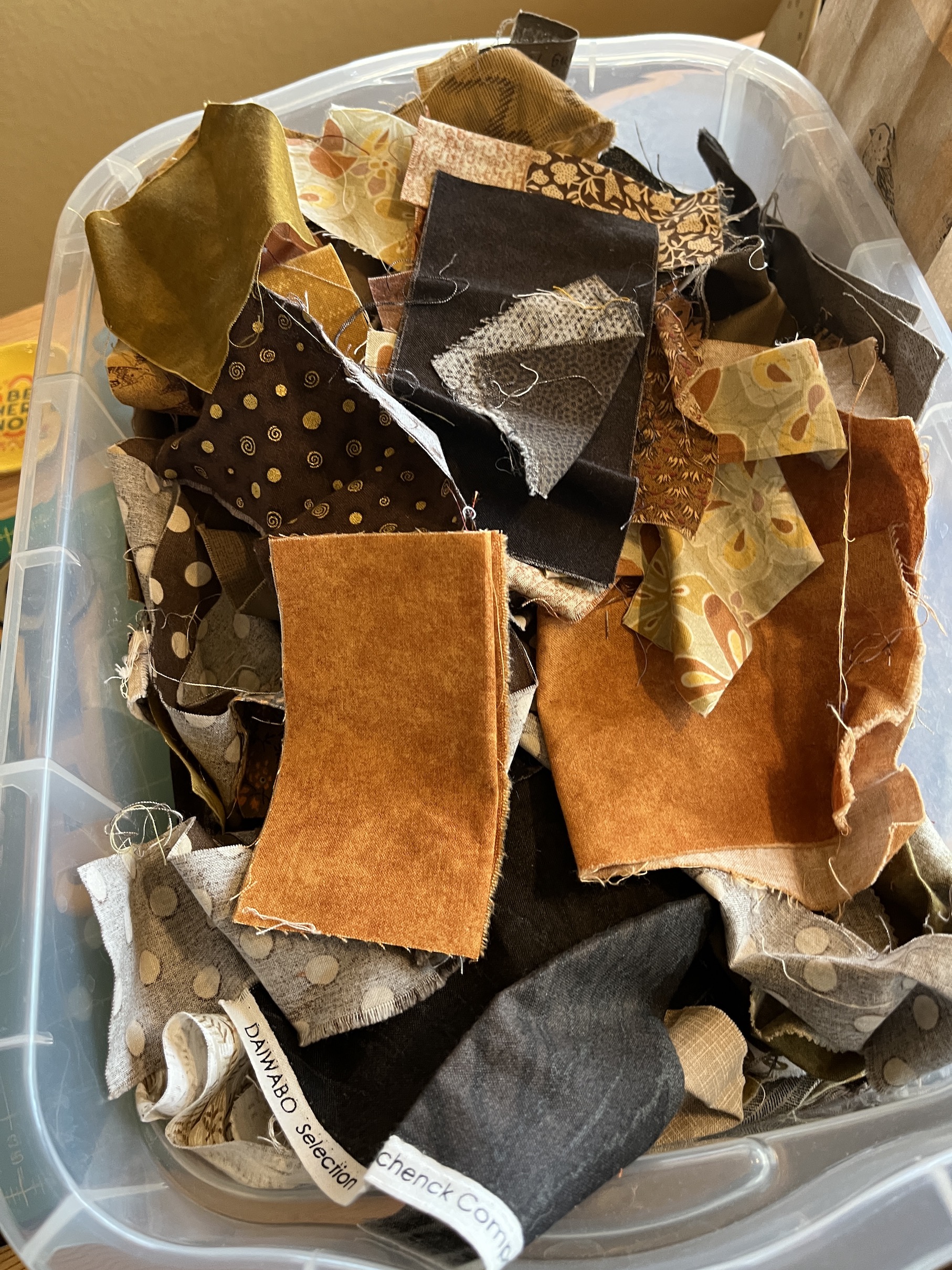
During the retreat I “shopped” from my collection of brown, cream, yellow and gold scraps and selected this collection of scraps to which I also added a couple orange-brown scraps and some scraps D brought to the retreat:
I ended up piecing 46 blocks, which I narrowed down to 42 blocks plus one spare (I recycled into the scrap pile 3 blocks that were pieced too wonky).
At first I decided to float the blocks (but framing them) in some coppery-gold-ish Peppered Cotton fabric I had in my stash:
Yes it looks cool and the framing fabric really compliments the fabrics in the blocks, but I decided it would just be too much as an entire quilt.
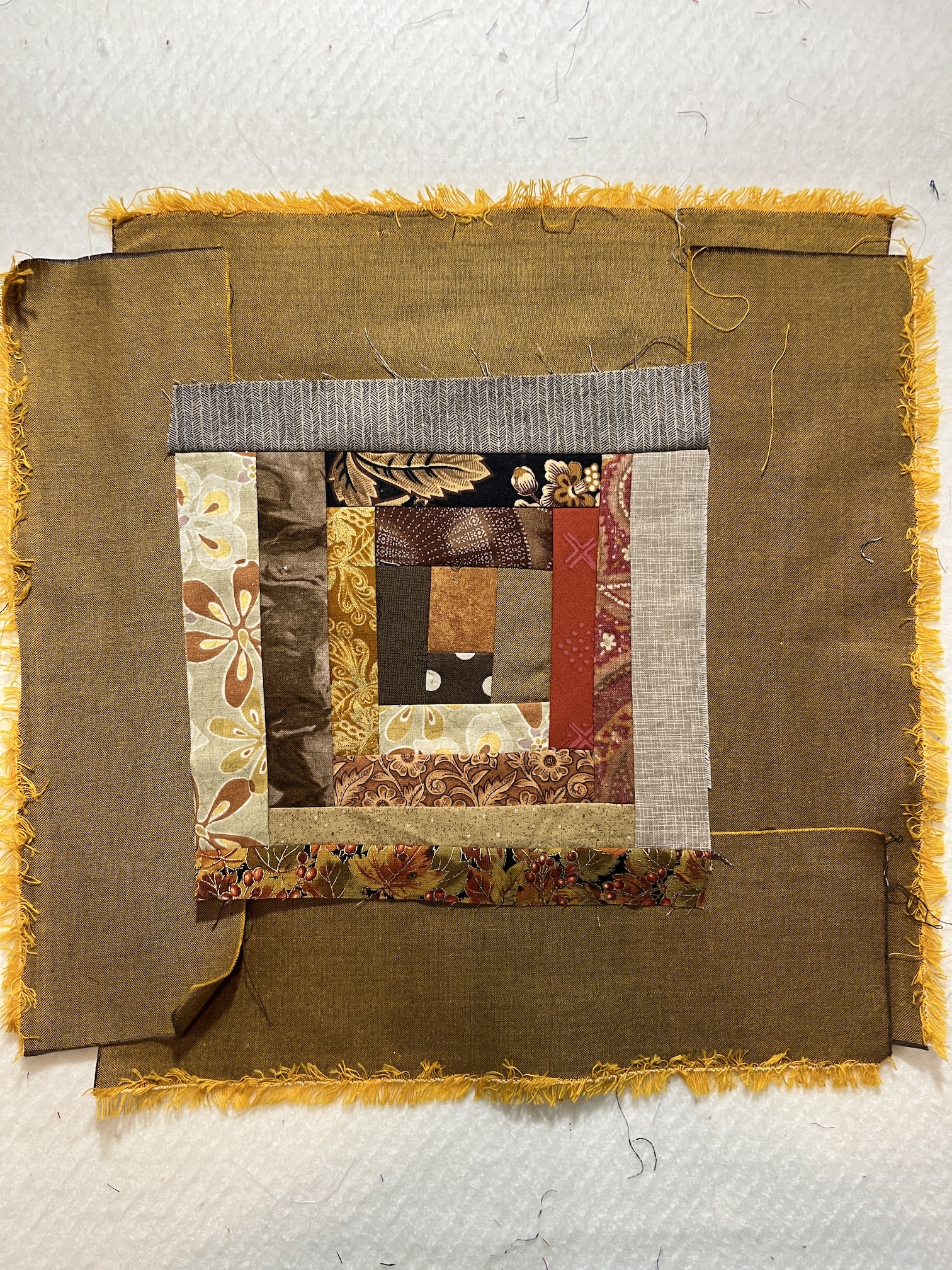
So I pulled out this brown-taupe-ish Peppered Cotton fabric I had in my stash:
And I decided I would first frame each block in the coppery-gold-ish fabric and then set that block in the taupe-ish fabric:
It might be difficult to visualize as I have it laid out in the images above but I will share more images after I try out some sample final blocks. Creating some sample final blocks will also let me confirm that this combination actually works.
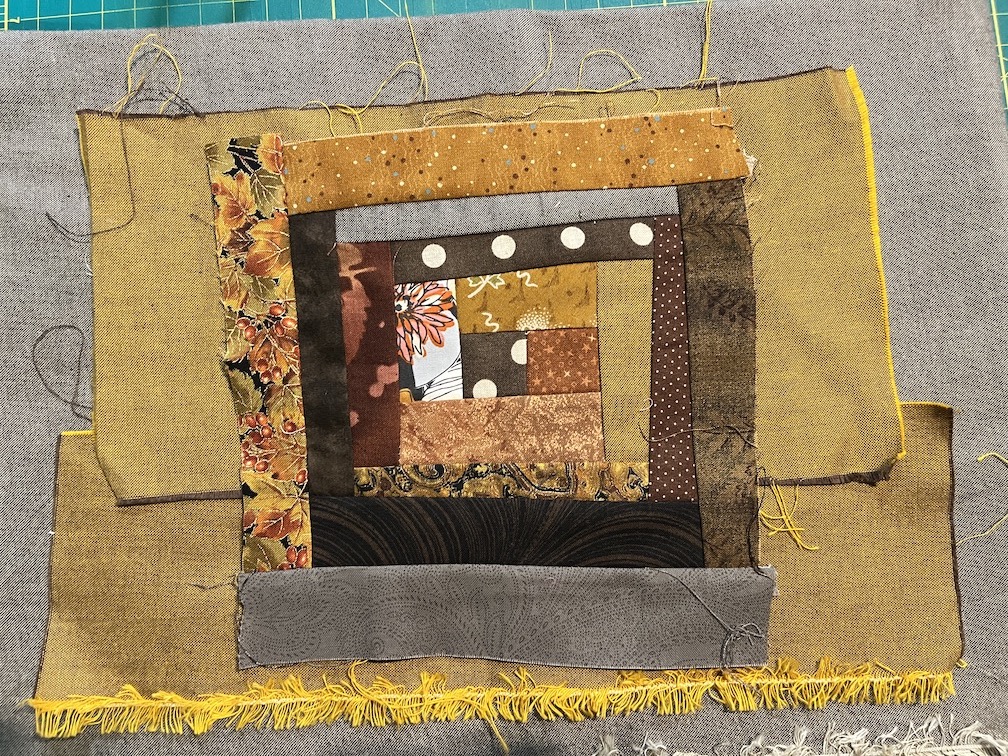
We used this method during the retreat – I suggested (and they listened) to K and D that they actually sew a sample final/completed block to decide if they really like a framing/border/lattice color for their block. Just laying the block on the fabric doesn’t already give you the true feeling of the final version. You can always rip it out the framing and reuse the core block if you don’t like the sample.
Here is an example below of what D did during the retreat with her two finalists – the khaki colored fabric vs. the gray fabric – to help herself make the final decision:
A friend who read the posts related to the retreat ask for some overall instructions on making scrappy improvisational log cabin blocks (which I also call “log jamming” or “free form” log cabin blocks).
Here is a quick overview of how I do it, there are several different approaches and in the post ScrapHappy May: Scrap Happy Retreat! I shared links to YouTube videos from the Stitchin’ Post where I first learned how to do it.
IMPROVATIONAL/FREE FORM SCRAPPY LOG CABIN BLOCKS
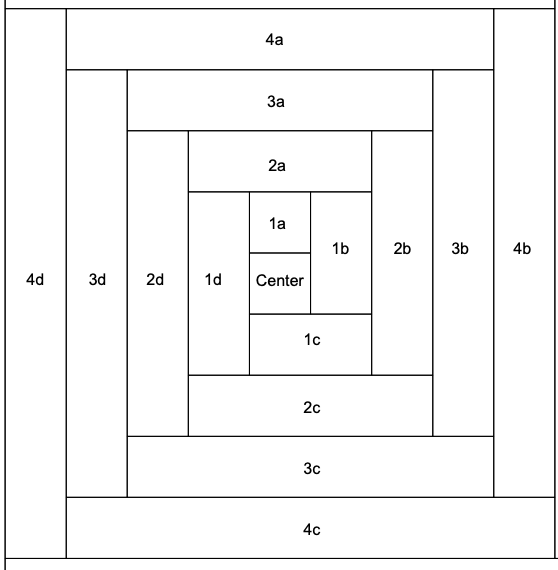
First you need to understand the concept of Log Cabin Block piecing where you start with a center square and build around it. Below is a screen shot from Generations Quilt Patterns on How to Make a Log Cabin Blockthat illustrates the Log Cabin Block piecing concept:
It really helps to have pieced traditional log cabin blocks before you go improvisational.
Next you need to decide what size you want your final block to be. I decide my final size based on existing square rulers I have as the easiest way to trim the block is using a square ruler on a rotating cutting mat. I have the following square rulers in my collection – 6 inch, 6.5 inch, 9.5 inch, and 12.5 inch, so I make my final blocks one of those sizes. D & K used my 9.5 inch square ruler for the final size on their blocks. I plan to use my 12.5 inch ruler for the final size on my blocks.
Then it is time to go shopping in your fabric scraps. You need to decide on a color palette (though you could do all random colors but your piece will not look cohesive if that is what you want, but it will look colorful!) for your quilt blocks. As you can see from the pictures from our retreat – K went with pinks and blues, while D went for autumnal colors. You are going to need more scraps that you think so at least initially put together a large pile of scraps.
Audition your scraps and see how well they work together by laying out a demo block (no need to sew together yet but try and simulate a log cabin block).
To start you can either 1) sew two strips together, one of the strips being your center fabric; or 2) sew different little pieces of centers to a long strip.
Cut them apart using scissors to create your first two pieces – if you look at the graphic above this would be Center + 1a.
From there you can create using log cabin piecing techniques a sample block to see how you like it, or just jump into chain piecing blocks starting with your fabric for 1b.
Don’t worry about 1/4 inch seams, just do what seam allowance works to piece the fabric to the next fabric – for example if you are using thin scraps you can use 1/8 seam allowances, especially when you are working on rows towards the center, it will end up stable when the entire block is sewn together.
Using log cabin piecing techniques (working from a center around and around) keep adding scrap strips until you get your block a little larger than the final size you want to achieve.
Trim your blocks using the square ruler of your choosing to their final size.
I might write an actual pattern of how I do it with lots of images/photos and detailed instructions and sell it as a digital download on my Etsy shop someday. Then I can add in all the tricks I’ve learned over the years of making these blocks. My process does differ from the one I originally learned from Jackie at the Stitchin’ Post.
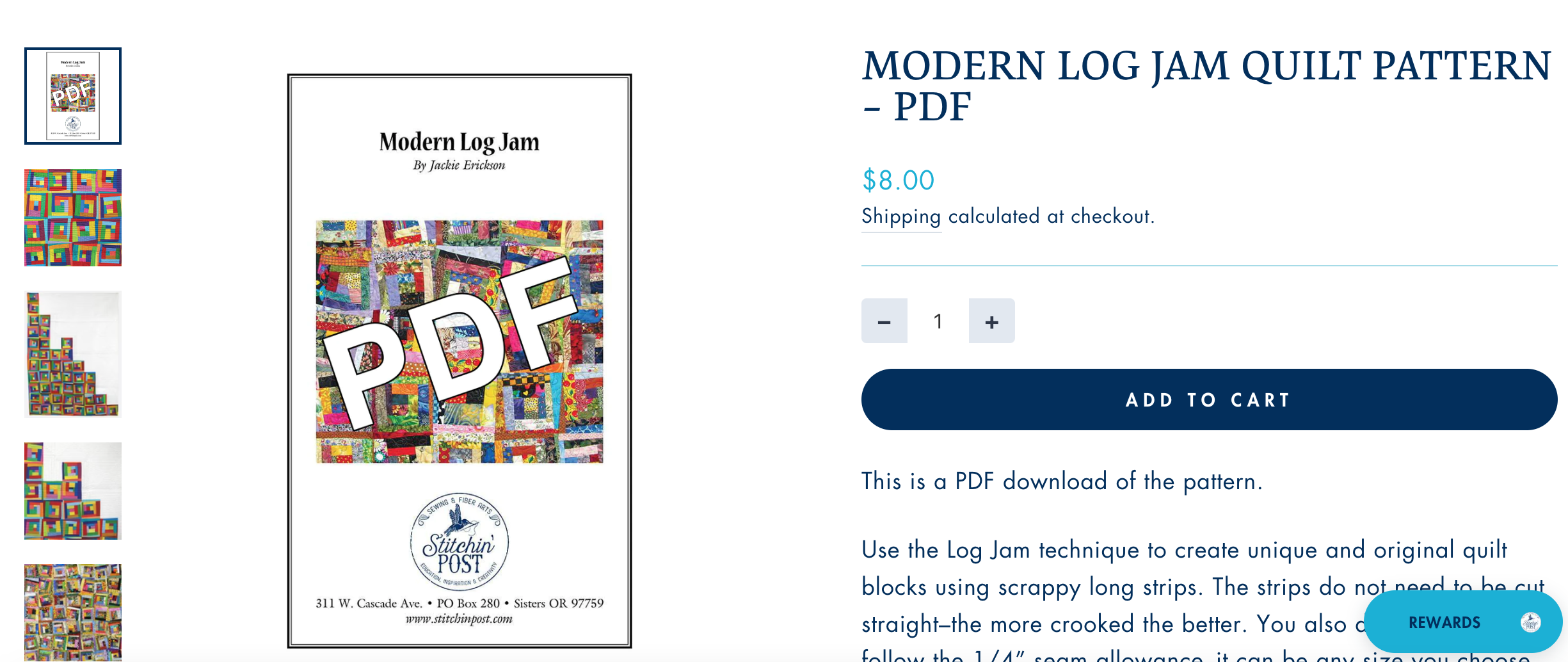
The Stitchin’ Post does sell a pattern for making these blocks called Modern Log Jam Quilt in case you want to try their pattern. It was written by the person (Jackie) who originally taught me (before I created my own process) – I’ve linked it here – Modern Log Jam Quilt.
Stitchinpost.com
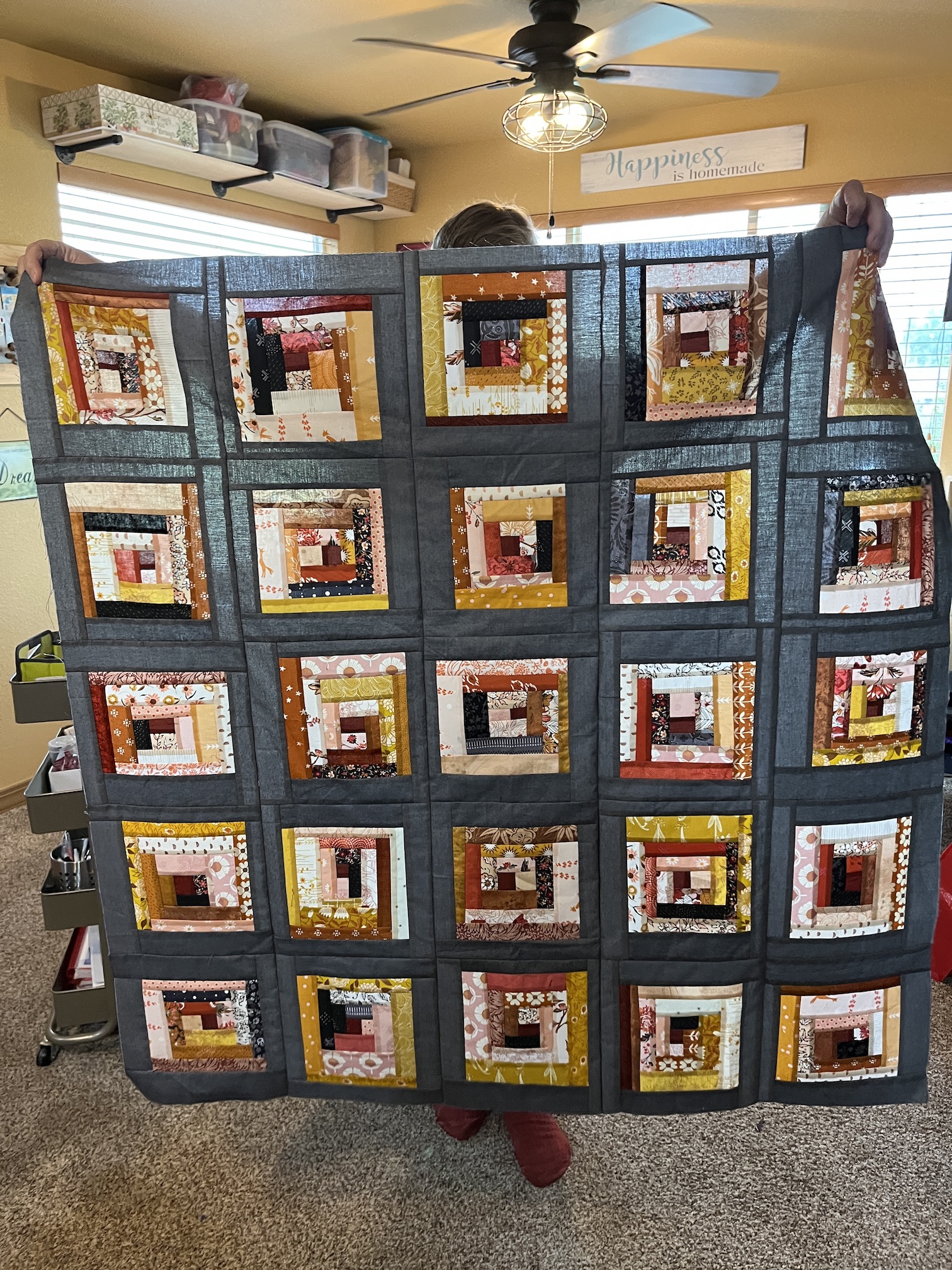
There are so many options of what you can do with these types of blocks made from scraps. You could do something straightforward like what D made:
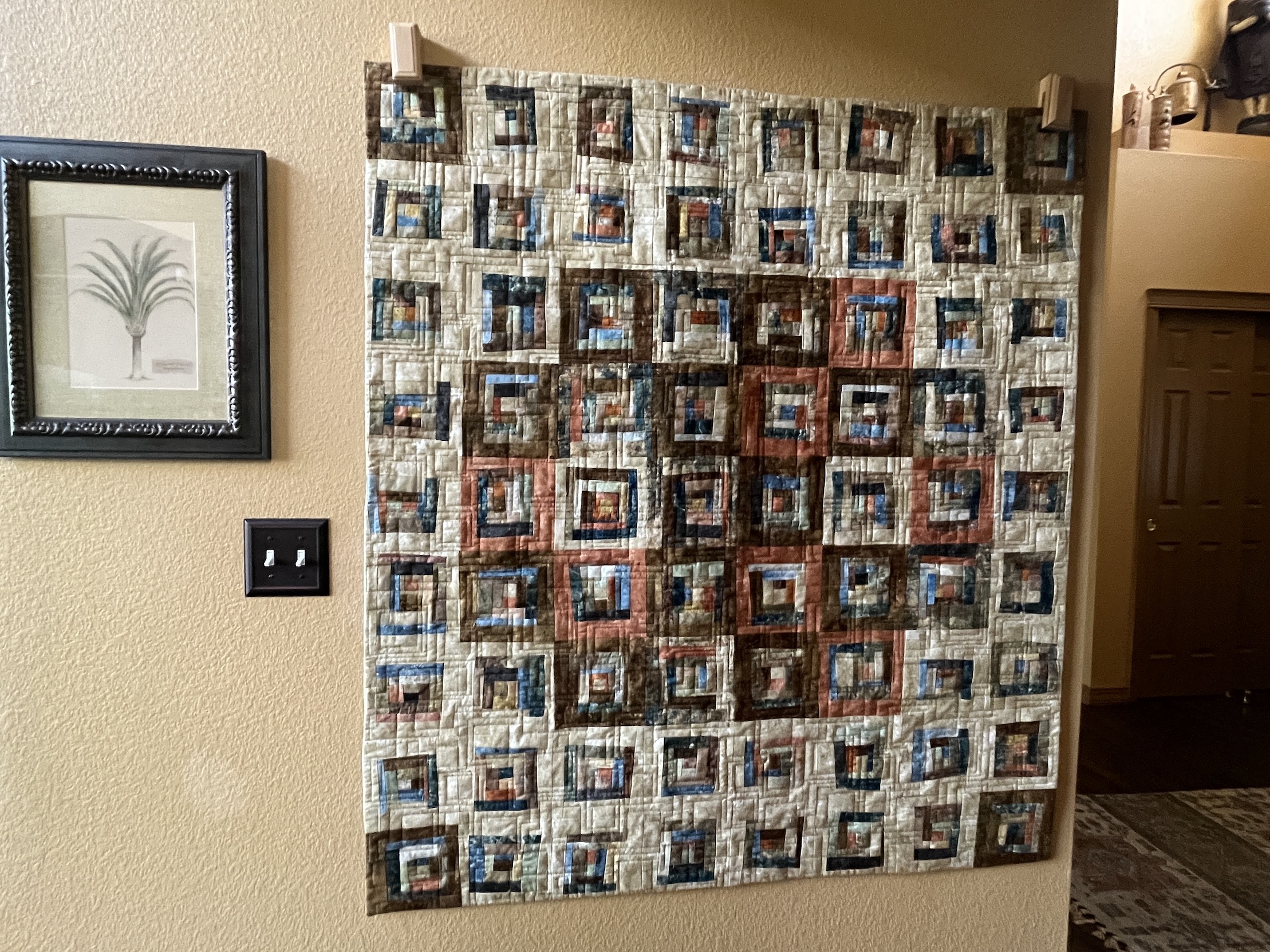
Or you could play with using different framing colors and create additional patterns like this one I made out of Stonehenge fabric scraps:
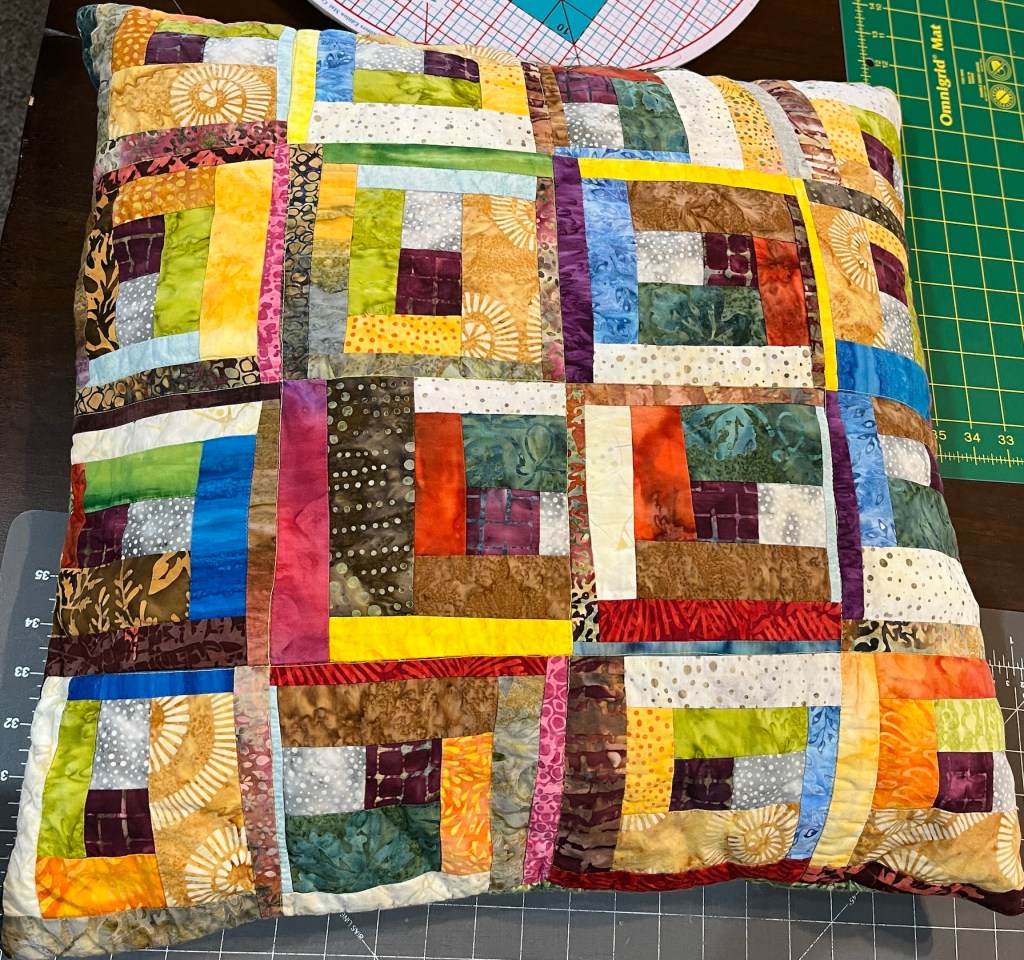
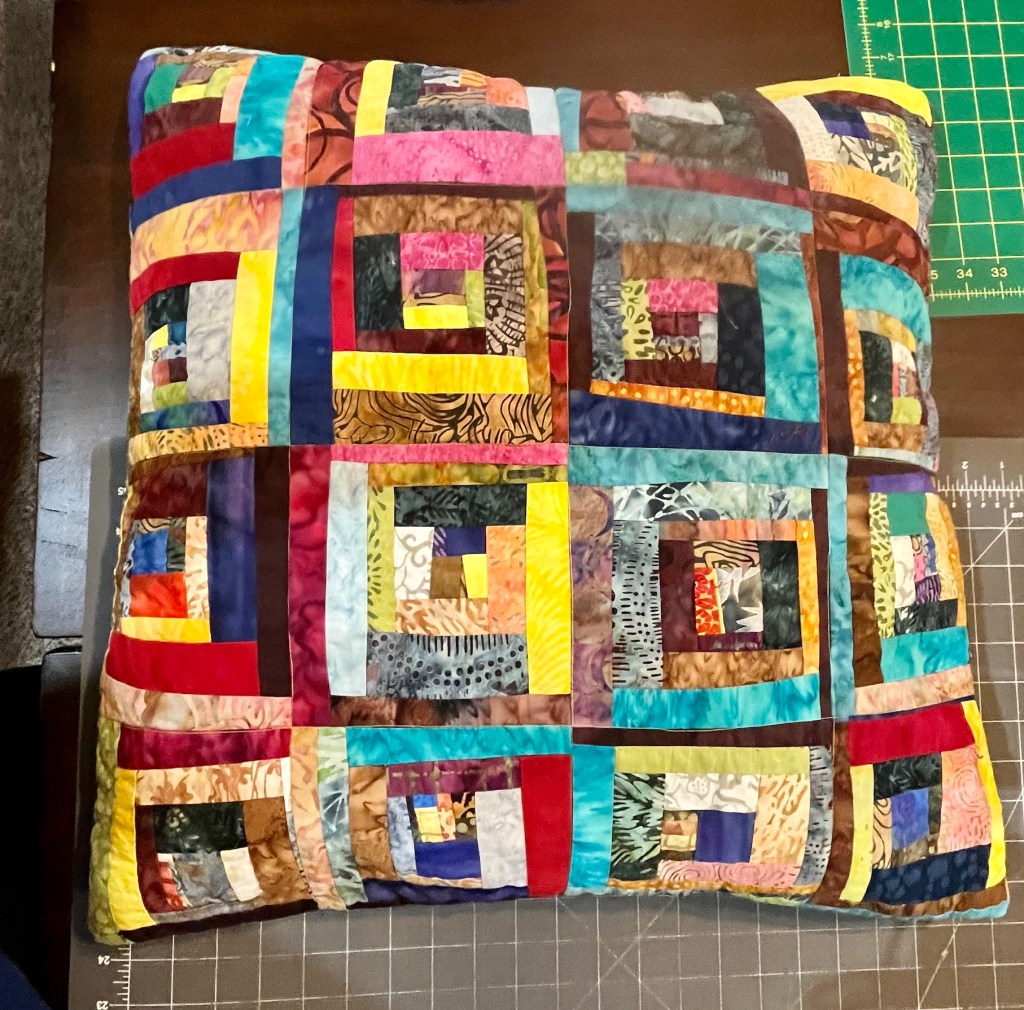
Or you can skip the “framing” of the blocks in a solid color and just sew the blocks directly together like I did for these two pillows I made out of batik scraps:
I’ve made numerous free form log cabin quilts this way.
Okay time to take a break from “tierneytravels” and get back to “tierneycreates” (smile).
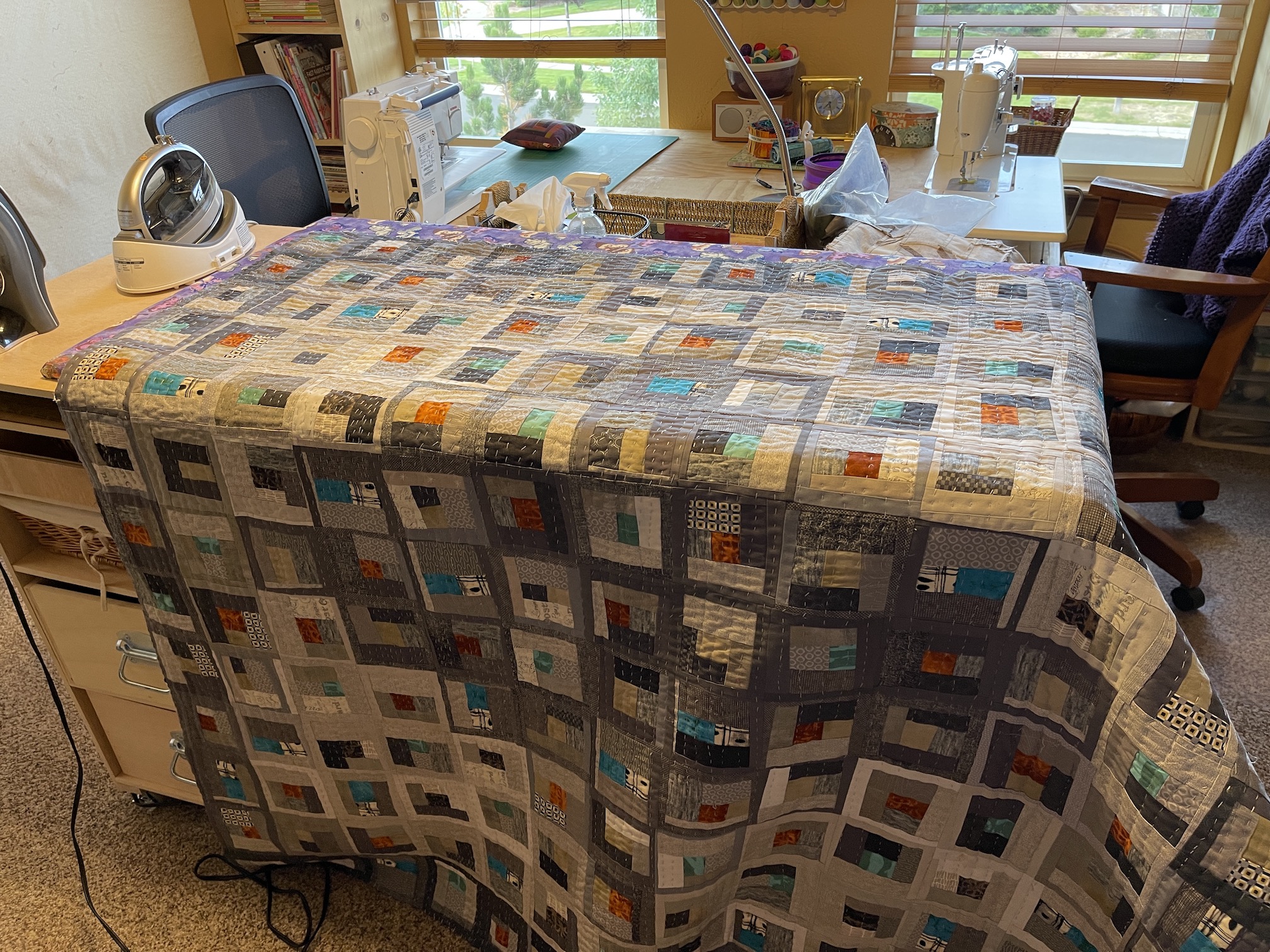
It only took like a year+ but I’ve finally finished hand quilting a lap sized free form log cabin quilt I started back in January 2020 at a quilting retreat which I named “Seattle Scrappy”. Now I need your help to decide which fabric to use for the quilt binding.
I know crafters are opinionated and like helping other crafters with their design, so I am looking for your opinions.
But firsthere is a little quick background on the piece and some additional photos.
In January 2020 (before the pandemic was a reality) I attended a mini quilt retreat with a couple quilting friends in Poulsbo, Washington. I brought a couple hand work projects and had EVERY INTENTION of only working on my hand work projects. But, my dear quilting friend Dana brought an extra sewing machine (one her her Berninas, and I love Berninas) and a BAG OF GRAY FABRIC SCRAPS for me to play with – oh no!
Out of that bag of scraps came a whole lots of free form pieces log cabin blocks and you can read about those in this post – What’s on the…Design Carpet.
Since February 2020 I’ve had a series of posts on the evolution of this quilt:
I’ve had an update or two on my @tierneycreates Instagram feed since these posts but basically I’ve just been plugging along (when I remember to work on it) hand stitching it with perle/pearl cotton thread.
Last night I finally finished stitching it; and this morning I trimmed off the extra batting on the edges!
I didn’t have the best light when I quickly took these photos this morning, but they give you a general idea of the hand quilted quilt.
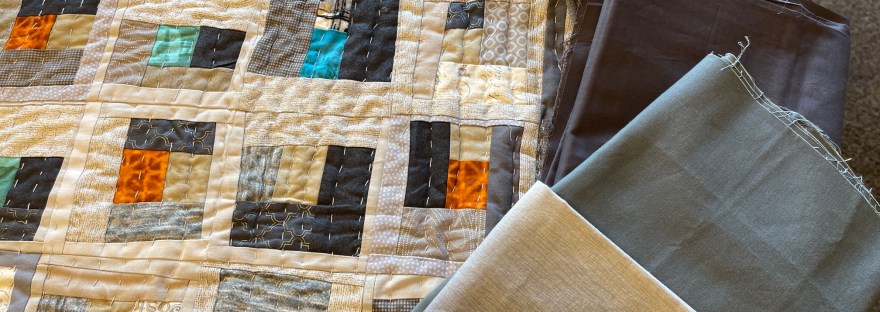
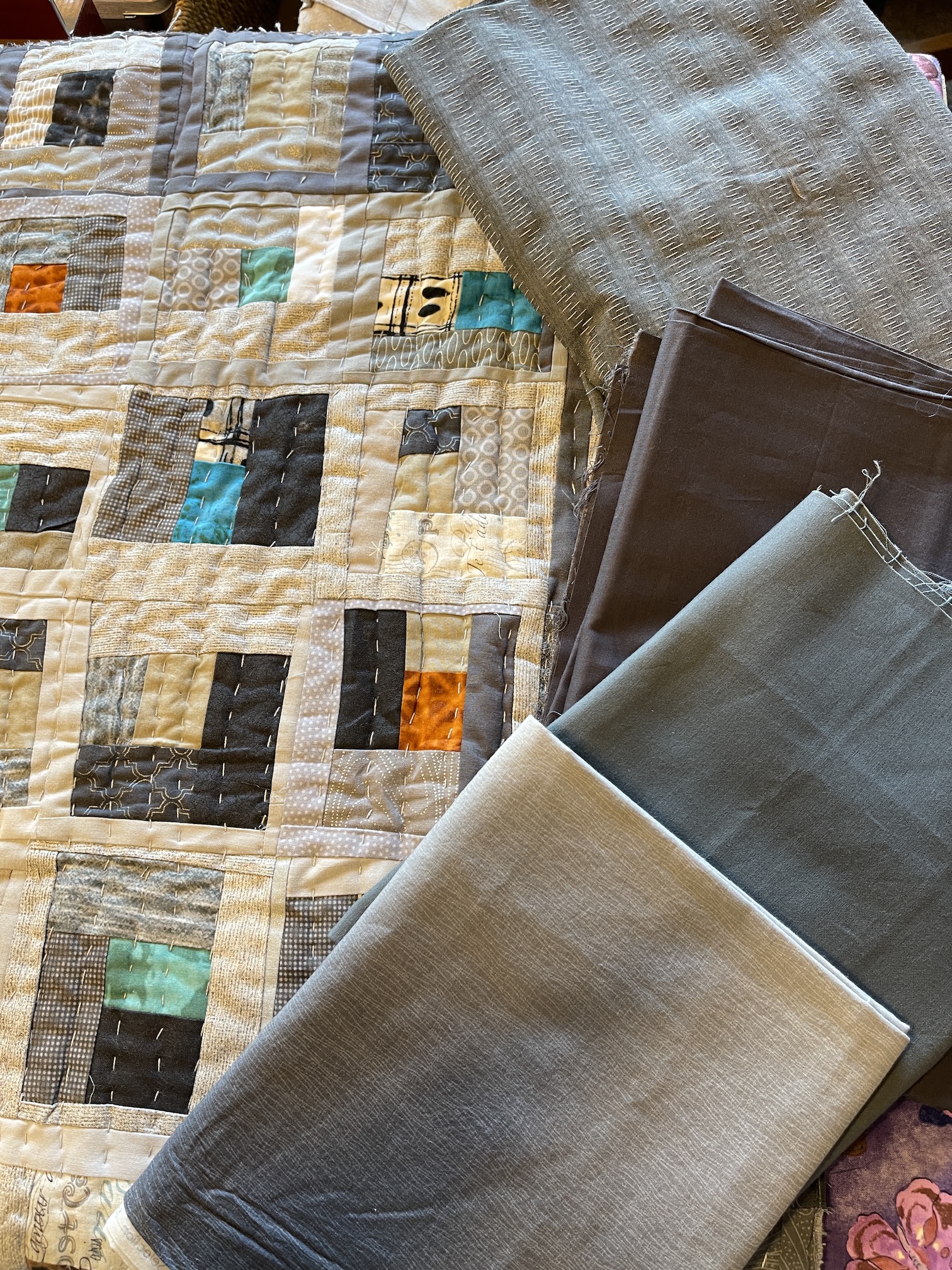
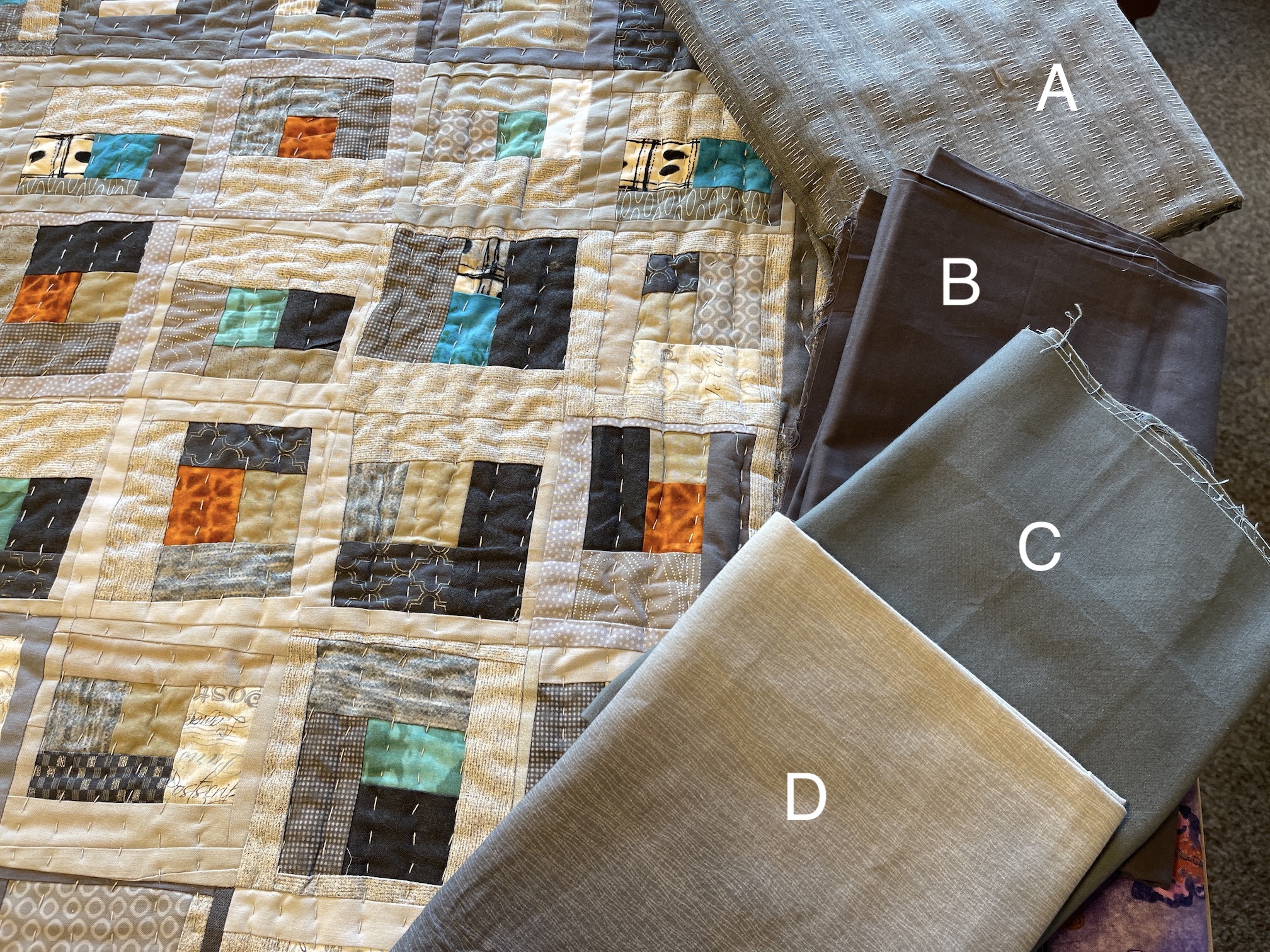
Now it’s time to choose the binding (this is where you come in) and here are the four options I am considering:
As you can see they are all some shade of gray. You might be thinking: “Well Tierney, what about the turquoise, aqua, or the burnt orange in the piece?” I did think about those for a moment but first of all I do not have enough of any of those fabrics to create a binding; and second I do not want to frame it in a strong color. I want to frame it in a gray.
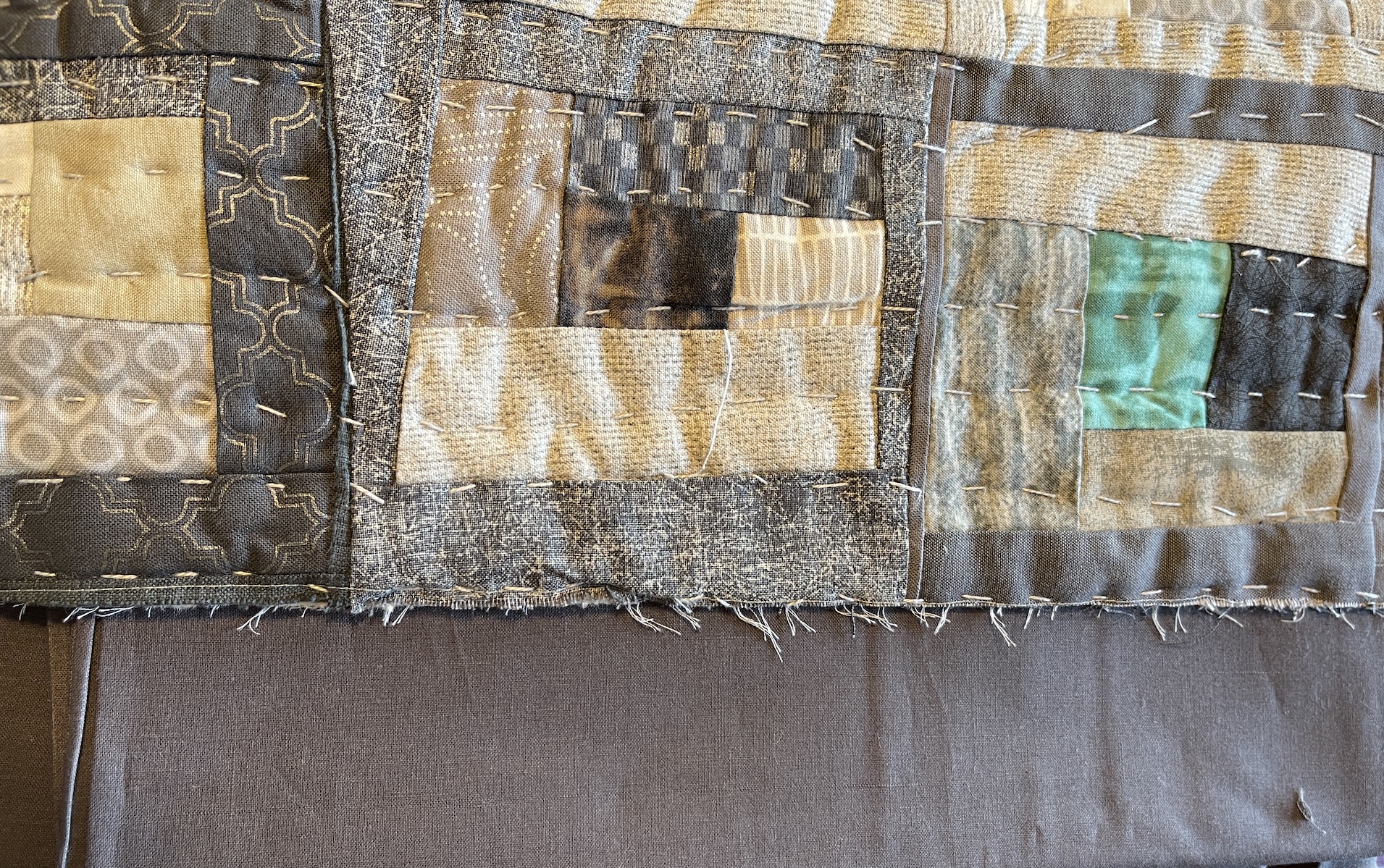
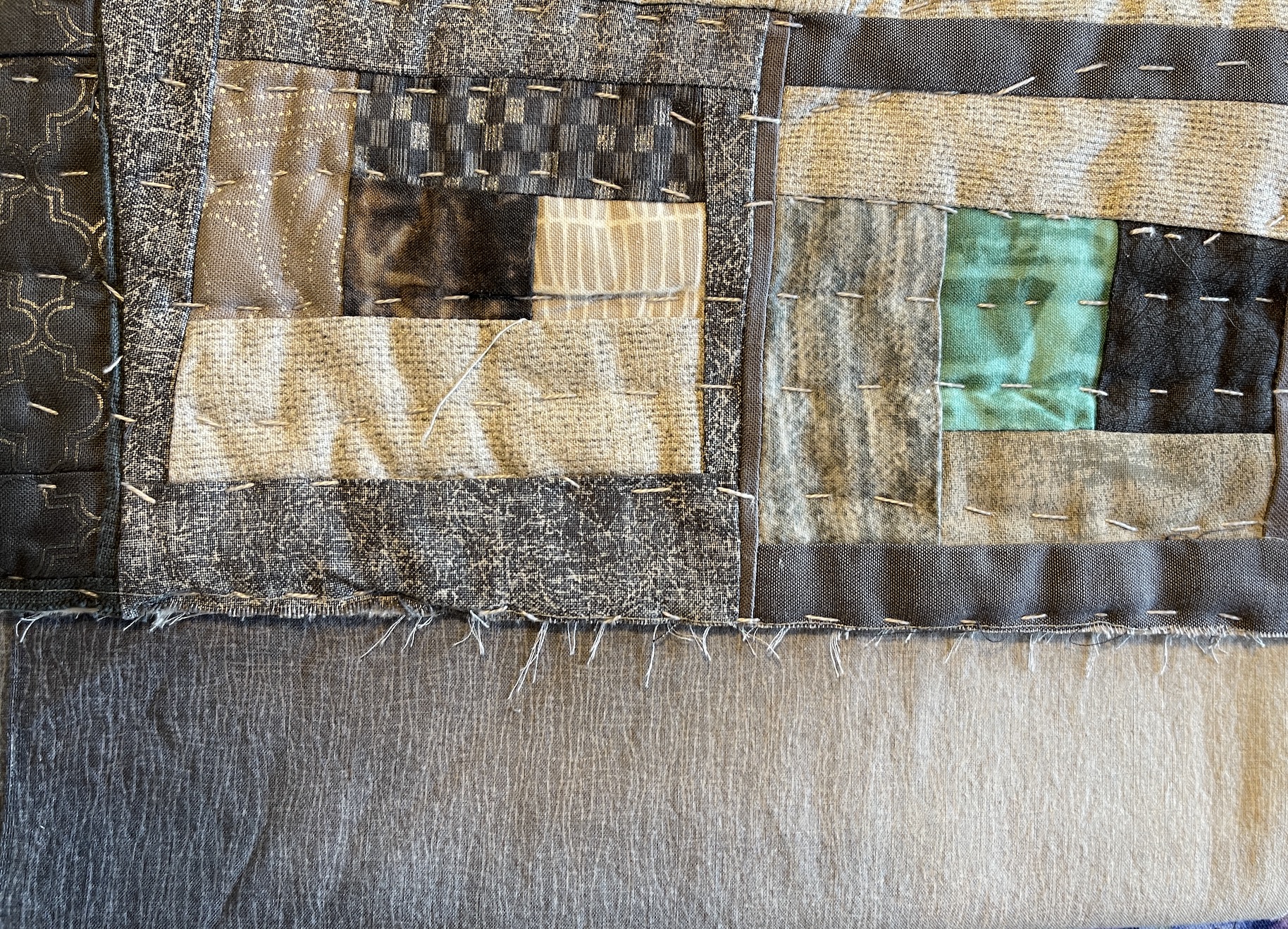
So here are the four gray fabrics up close up against the quilt for you to select from when you share your thoughts:
A – fabric with faux stitching pattern
Fabric A
B – medium-dark gray fabric
Fabric B
C– medium gray fabric
Fabric C
D – variegated gray fabric (the tone/shade of gray will change along the binding
Fabric D
Here is a poll below for you to vote and I will report back on the result of the poll and my final decision (which will likely be heavily influenced by your votes):
****If you’d like to participate in voting/respond to the poll, you have to go to my actual website. It will not show in the WordPress Reader, sorry (thanks @tammiepainter for making me aware). If you are in the WP Reader, click on “Visit Site”.****
I’d appreciate any additional thoughts you have in addition to your vote in the Comments section of this post.
Please note however, I will only tally votes through the poll above just to make sure I do not duplicate votes, thanks!













 tierneycreates