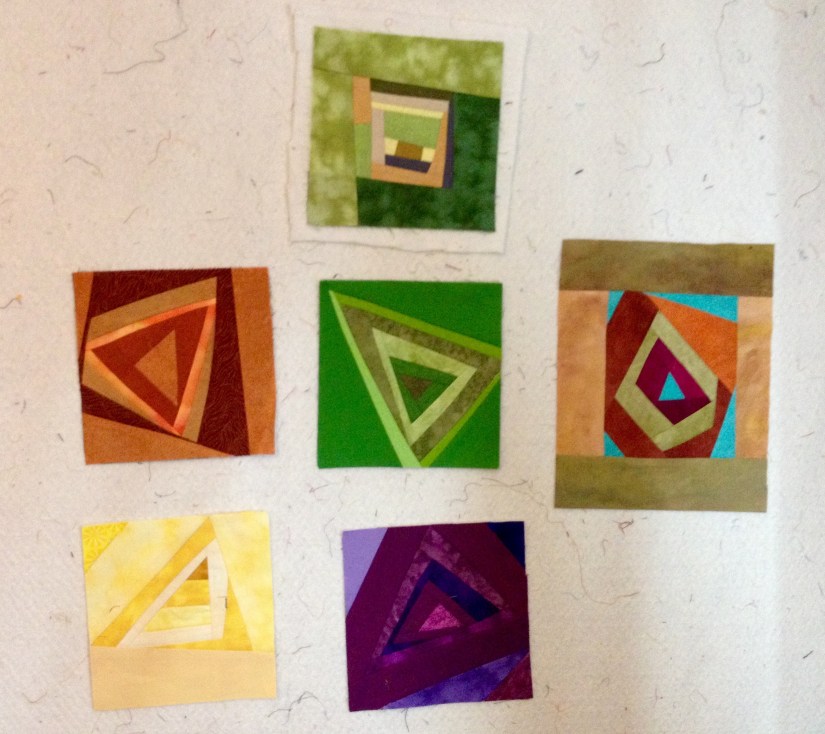
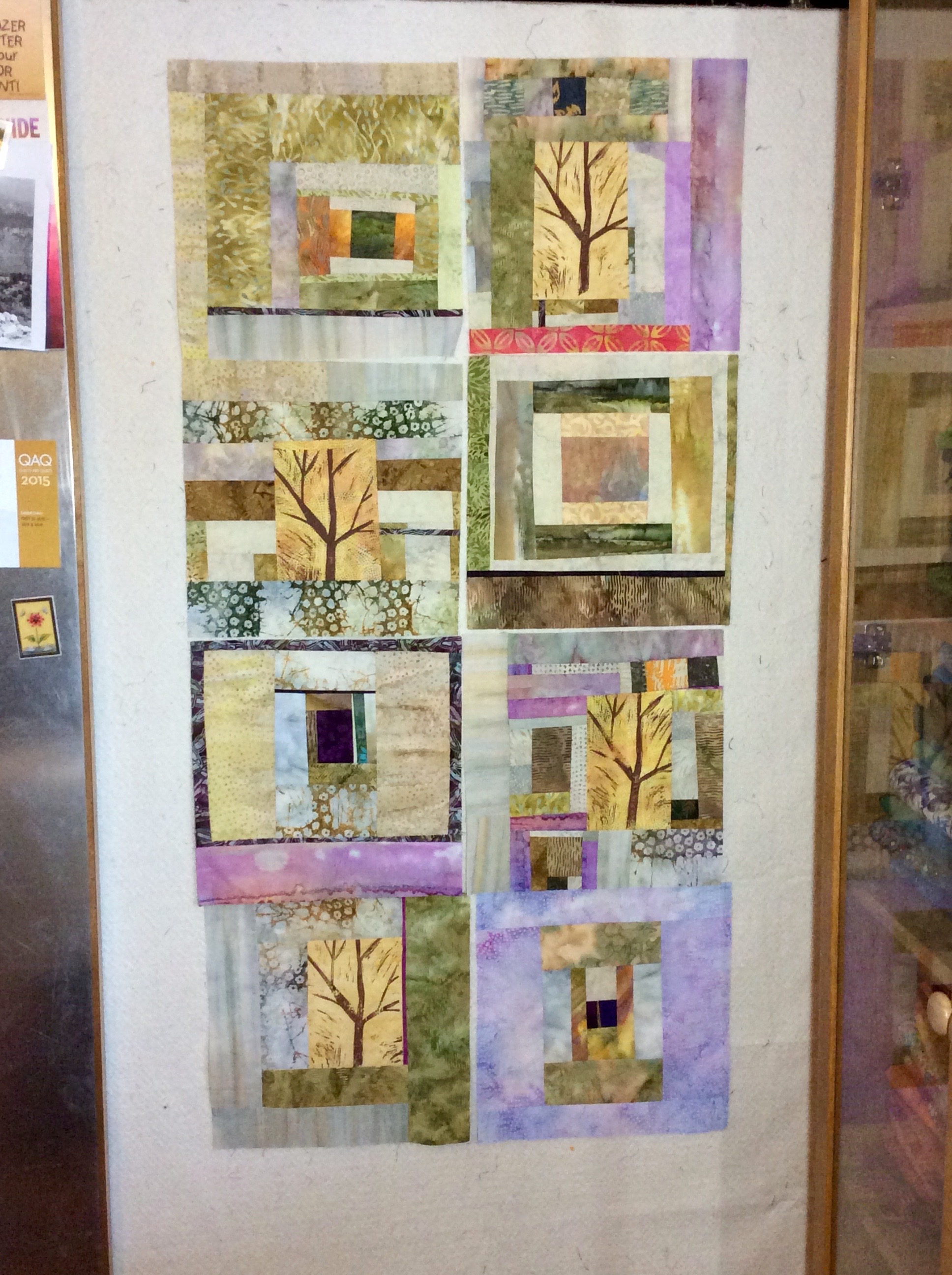
Interested in experimenting with solids, I made these 6.5 – 8.5 inch pieced blocks a couple of months ago. I recently put them up on the design wall to decide what I wanted to do with them.
I am thinking of making them a series of little decorative modern art pillows to sell on my tierneycreates Etsy shop.
(In addition to the oranges, greens, yellows and purples blocks I did, I also made one with blues and one with reds but I did not like the combination of shades of the blues or reds so they got recycled.)
Not all quilters are like me: saddled with a backlog of projects. I know quilters who (they are freaks!) work on ONE project at time, seeing it through completion, and not starting another project until their current project is complete.
My mind does not work that way. I am basically that golden retriever in the movie Up, who says “Squirrel!“when I see a new project to start. I am easily distracted and I tell myself I will get back to the current/previous project eventually.
I was having a bit of creative block on designing a new art quilt and I realize I need to work through my project backlog. So here it is sitting up the cutting table, festering:
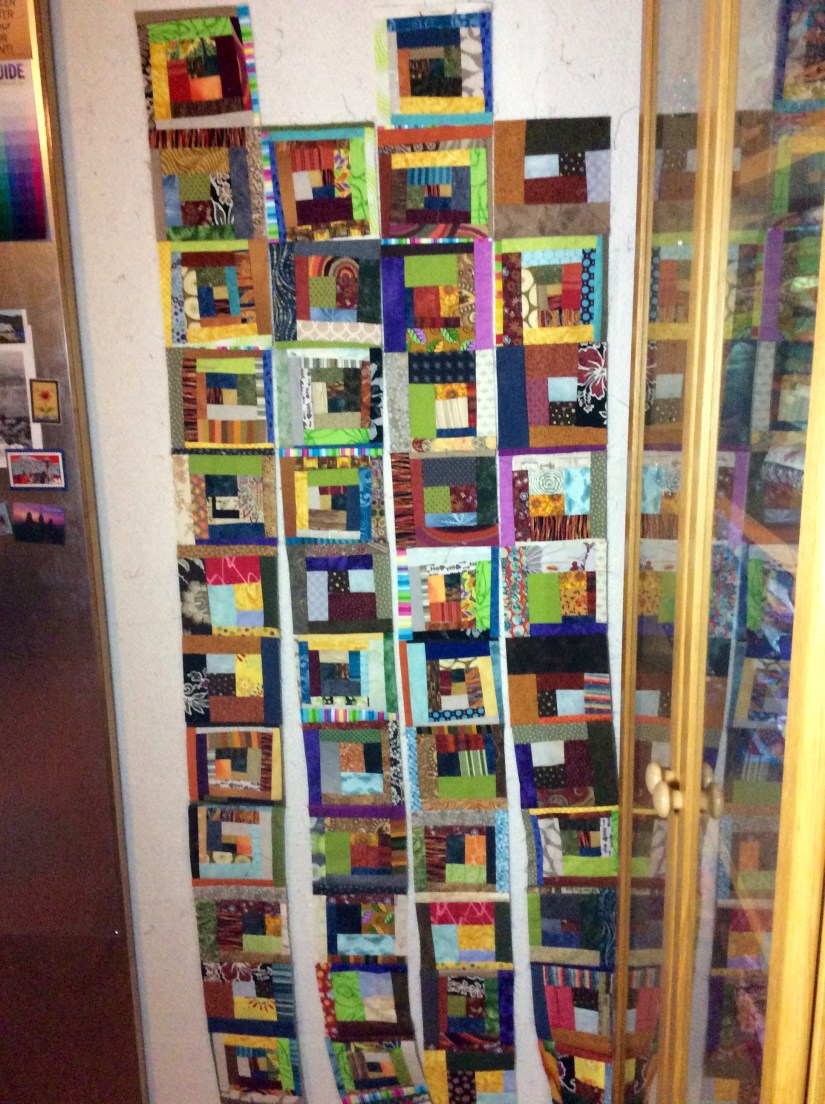
In this pile under the cutting table, I discovered 120+ 6.5 inch log jam blocks (scrappy pieced log cabin style blocks) that I had pieced earlier this year. With the assistance of Terry the Quilting Husband, I got them sewn together and now they are on the Design Wall awaiting assembly of the rows.
I have a total of 10 rows with 12 blocks in each row. I am hoping that by floating the pieced blocks in a solid color border, I can make it a twin, full or queen size quilt top. I will post a photo when the top is complete (before it journeys to the long-arm quilter).
“Never put off till tomorrow what may be done day after tomorrow just as well.” – Mark Twain
This post is really the “Part II” of the previous post: “Creative Inspiration: Where I Started…” in which I discuss my inspiration to create series of small recycled clothing quilts based on the first quilt book I owned: Quilts! Quilts!! Quilts!!! (McClun & Nownes, 1998).
The “Big Magic” of Creativity
I am currently listening to a wonderful audiobook by Elizabeth Gilbert, read by the author – Big Magic: Creative Living Beyond Fear (2015). In the inspirational book Gilbert proposes that Ideas are entities unto themselves that move among us searching for a home/host to bring them fully into existence.
If an idea visits you and you do not grab onto it, it will move to someone else. She also discusses the concept “multiple discovery” (simultaneous inventions by different individuals not aware of what the other is working on). She proposes that when an Idea is ready to “be born”, it will visit numerous people to find someone who is going to bring it into existence. This is all part of the “Big Magic” and mystery of creativity and the creative process.
The Ohio Star Idea (magical “multiple discoveries”?)
In the previous post, “Creative Inspiration: Where I Started…“, I share my recent experience of being in a thrift store with friends and having the idea to do some traditional pattern small quilts using recycled clothing for The Wardrobe Meets the Wall collection.
The traditional quilt pattern “Ohio Star” popped into my head. I mentioned to my creative partner on The Wardrobe Meets the Wall my idea of making some recycled clothing/garment manufacturing samples quilts based on the Quilts! Quilts!! Quilts!!! book. I did not mention that the traditional pattern, “Ohio Star” had popped into my head.
At first she hesitated on the concept and then remarked: “An Ohio Star done with the recycled silks would be interesting”.
The Quilts! Quilts!! Quilts!!! book does not contain the Ohio Star pattern. It was like we both just came up with the same idea at the same time! I was completely overwhelmed that she randomly mentioned “Ohio Star” when I was thinking it at the same time. There are so many traditional quilt block patterns – why did “Ohio Star” pop into both of our minds.
The Ohio Star Silk Experiment
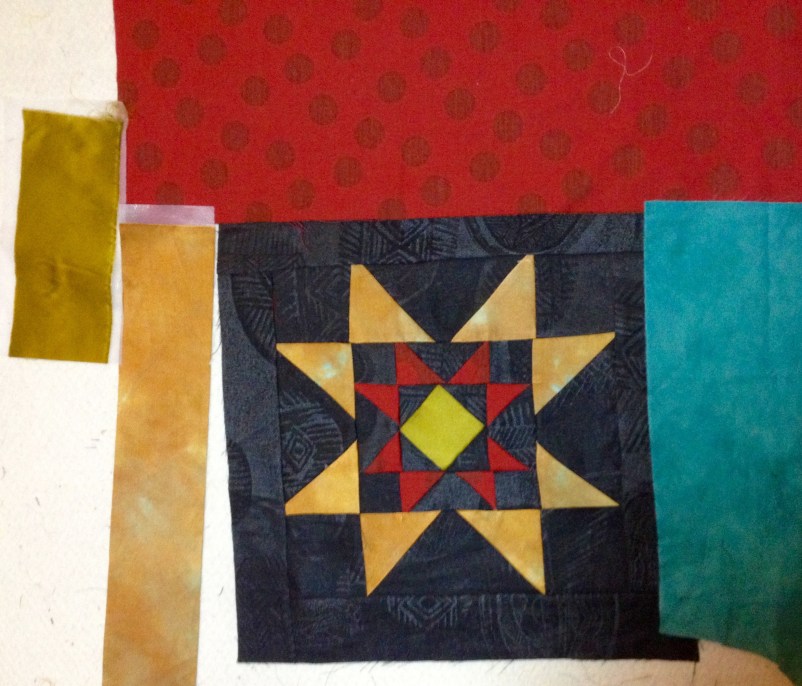
Of course, I had to try and make a small recycled clothing quilt with the Ohio Star quilt block pattern! I found an image of an “Ohio Star” on the web and reverse engineered it.
My challenge: The quilts I have made so far from recycled clothing materials, such as silk garment manufacturing samples, have been using free form, intuitive piecing techniques. In order to create a traditional Ohio Star block, I had to use more accurate piecing techniques.
Using a special interfacing, I backed on the thinner silk pieces to stabilize them for cutting into specific small shapes (such as triangles). Silk is not as forgiving as cotton when piecing a block and it was a new experience to try and make a traditional block with silks!
On the design wall photo below, you will see I have completed the basic Ohio Star block. I am working on an inner border and outer border for this piece. I will post the completed small quilt top in the future.
Ohio Star, recycled silks (in progress on the Design Wall)
I consider this experiment a warm up for the project to make a series of small quilts from recycled clothing inspired by traditional quilt patterns from Quilts! Quilts!! Quilts!!!
Yesterday the long-arm quilter, Guadalupe Designs, unveiled the quilting done on my piece Abandoned Structure, which is based on an abandoned power plant in Central Oregon that I photographed many years ago.
Once I got it home I stuck it up on the Design Wall (a sort of homecoming from where it originally was born). I have not yet trimmed the batting from the edges or put the finish on the edges, but I am enjoying just looking at the piece as it came off the long-arm quilting machine.
I am excited to add it to my collection of art quilts made from recycled clothing and garment manufacturing scraps.
Abandoned Structure (2015, in progress). Designed and pieced by Tierney Davis Hogan, Quilted by Guadalupe Designs
I found an organic branch-like/wood grain-like tone on tone fabric from my collection of Marcia Derse fabrics and placed it between the columns and then as the border.
So now the quilt top is done!
I am looking forward to seeing what it looks like once the machine quilter works her magic!
Some photos below…
NOTE: In the last photo, the quilt top looks a little askew, that is just because The Quilting Husband is trying to hold it still for the photo while the wind is blowing.
A close up of one of the blocks with the setting fabricThe Tree Outside My Window under a tree outside my window!Quilt Top completed on The Tree Outside My Window
Continuing my series “What’s On The Design Wall” with an update on where I am in my design and piecing of a new piece that I first introduced in the post: “What’s on the Design Wall: Rescued Blocks II“.
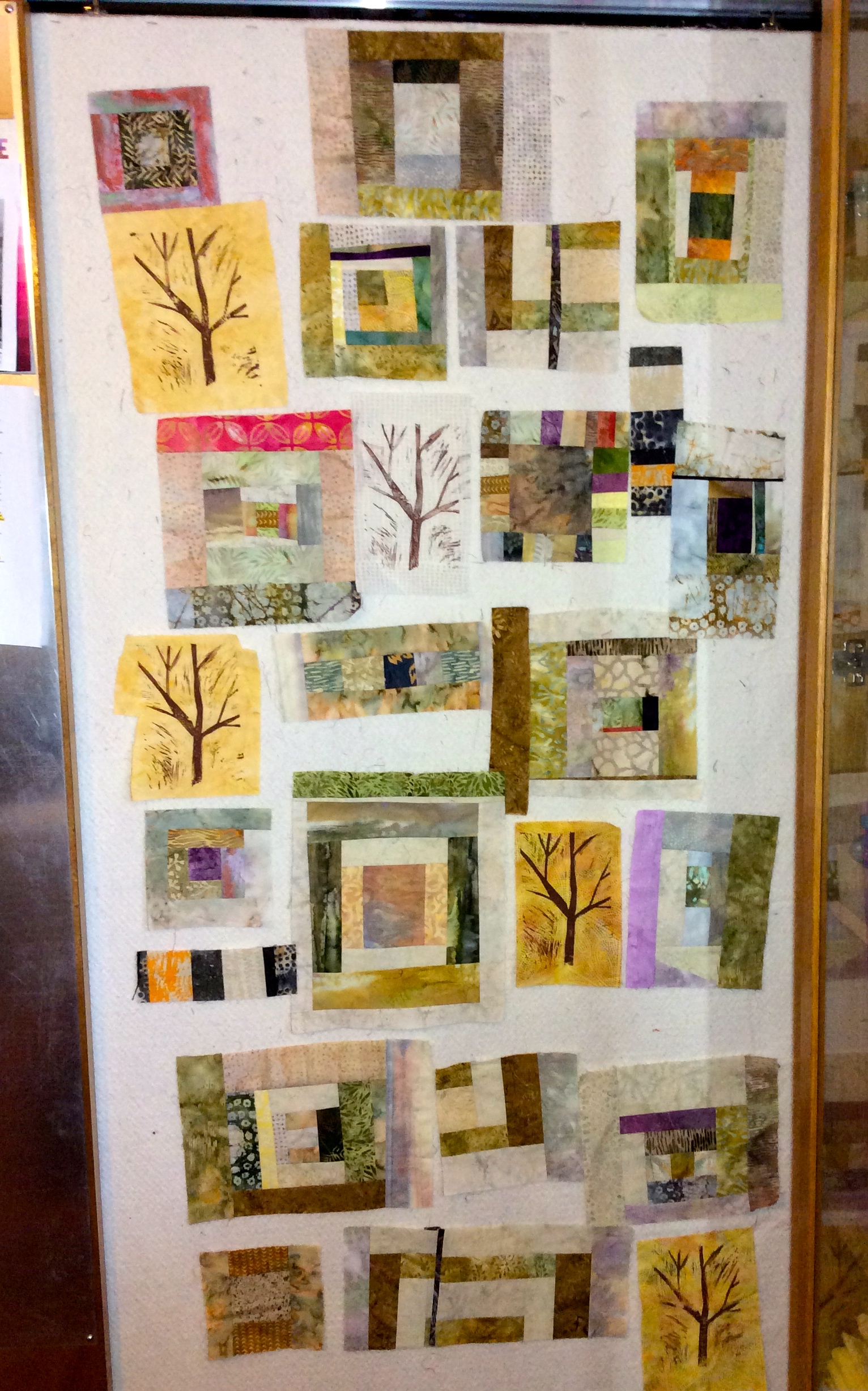
Recently, the name for this piece came to me – “The Tree Outside My Window” as I completed 15 blocks to create this art quilt.
As you will see in the photos below, this piece has FIVE images of trees in it (the post “What’s on the Design Wall: Fabric Surface Design Experimentation” discusses how these trees were created) but “The Trees Outside My Window” did not sound right on my tongue. I believe when naming a piece, it has to sound right to you when you say the name aloud.
After creating fifteen 12.5 inch by 12.5 inch blocks from: 1) 4 inch – 10 inch blocks originally pieced by a friend (“Rescued Blocks”): 2) scraps from my friend; and 3) five printed trees from a surface design workshop, I decided to piece the blocks into 3 columns of 5 blocks each.
Now I am deciding what I want to do next with my design. I am leaning towards putting a strip of solid (or solid like) fabric in between each row and then floating it in the same color as a border. Originally I was going to use a cream batik but it did not look right. Next I thought: “Ah a brown batik with texture would work”, but alas, I only had brown batik scraps in my stash.
Then my fabric stash spoke to me (which is good because I did not want to go out and buy more fabric as I am trying to use my stash)! I spotted the perfect fabric – mono color textured design yardage from my collection of Marcia Derse Riverwoods Collection from Troy Corporation. (At one point I was addicted to this amazing collection and tried to be a sample of all fabrics in this line from The Stitchin’ Post in Central Oregon.)
I am going to leave it a mystery for now which fabric from this beautiful collection I selected for the strips between the three rows and the border. You have to wait until the next post on this piece!
Here are photos from my design wall to include some close-ups:
Continuing my series of posts on what is on the design wall…
THE QUILTING HUSBAND IS BUSY AGAIN
I had some of my blocks up on the design wall and Terry “The Quilting Husband” was getting impatient. He kept giving me subtle hints (and not too subtle hints) about moving my stuff off the design wall so he can put his blocks up on the design wall (we have a small house and can only make 1 shared design wall work).
The Quilting Husband is working on a new “Log Jam” quilt (see my other posts on “Log Jamming” and “Log Jams” which are free form pieced log cabin style blocks) made with flannel scraps. I have a large box of flannel scraps from making flannel quilts and flannel quilt backs, and Terry came up with the idea of trying to use of the scraps making flannel log jam quilts.
As his confidence grows as a quilter, he gets comfortable with making his own design decisions. He found a stash of dog and cat themed flannel scraps and used them as the center so each block would feature a dog and/or cat face. Very creative!
In my post What’s on the Design Wall: Rescued Blocks II I shared that a quilter friend gave me a cool stack of batik freely pieced abstract fabric blocks that she no longer wanted to work on, and a pile of coordinating scraps of fabric. I was planning to combine those blocks and scraps with a couple trees stamped on batik fabrics, from a fabric surface design workshop I took earlier this year.
Here is what I started with:
After playing with the pieced blocks and assorted scraps for awhile, I decided to create 12.5 inch blocks. I am aiming for 15 blocks, so far I have 8. I am looking into non-traditional block settings once I complete the 15 (or more blocks).
Here is what it looks like now (so far):
in progress
Occasionally I wish I had a larger design wall to put more blocks up on during the design process, but I can use the top of a bed to continue my design layout when I have 15 blocks (or more). All sorts of ideas have been running through my mind (the fun of designing a piece) such as spacing out the blocks by setting them at wide intervals in a neutral fabric, etc. We will see how it turns out and of course I will post future photos!
POSTSCRIPT
I love good quotes! I came across this quote the other day that made me smile and reflect:
“Continual is the journey: Past sunset towards morning.” – Willis Eberman
Is this quote referring to my marathon art quilt design sessions where I lose track of time? Or perhaps my ongoing journey on my “tierneycreates” path!
In a previous post What’s Was On the Design Wall: Rescued Blocks I discussed the pleasures of working with “abandoned blocks“. Abandoned quilt blocks are blocks that another quilter does not want and gives to you or you find at a thrift shop or garage sale and decide to adopt!
Recently a quilter friend gave me a cool stack of batik freely pieced abstract blocks that she no longer wanted to work on in addition to a pile of coordinating scraps of fabric. I love batiks and I love her combination of colors so I was very excited to adopt these blocks! As a bonus I discovered that the trees that I printed on batik fabric during a fabric surface design workshop I took in April (see post What’s On the Design Wall: Fabric Surface Design Experimentation), appear to work well with the newly adopted blocks!
Below is the piece in it’s very early stages (I threw all the adopted blocks and my tree printed blocks up on the Design Wall in a random manner) and we’ll see how the piece progresses. You know I will post updates.
My friend who also likes working with abandoned blocks (she collects them from thrift stores, garage sales and guild meetings) and I joke about someday having an exhibit of our collection of pieces made from other’s discards!
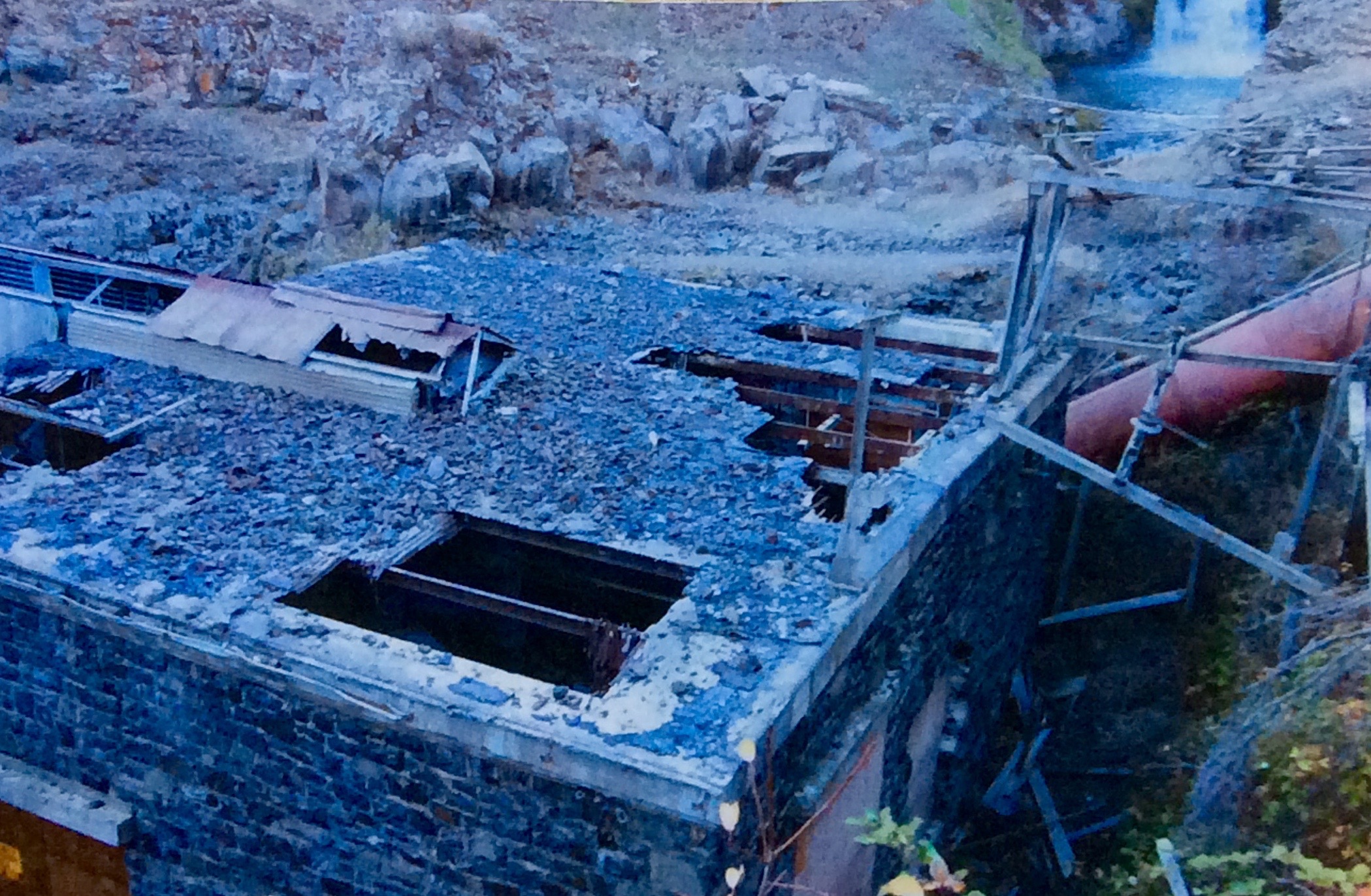
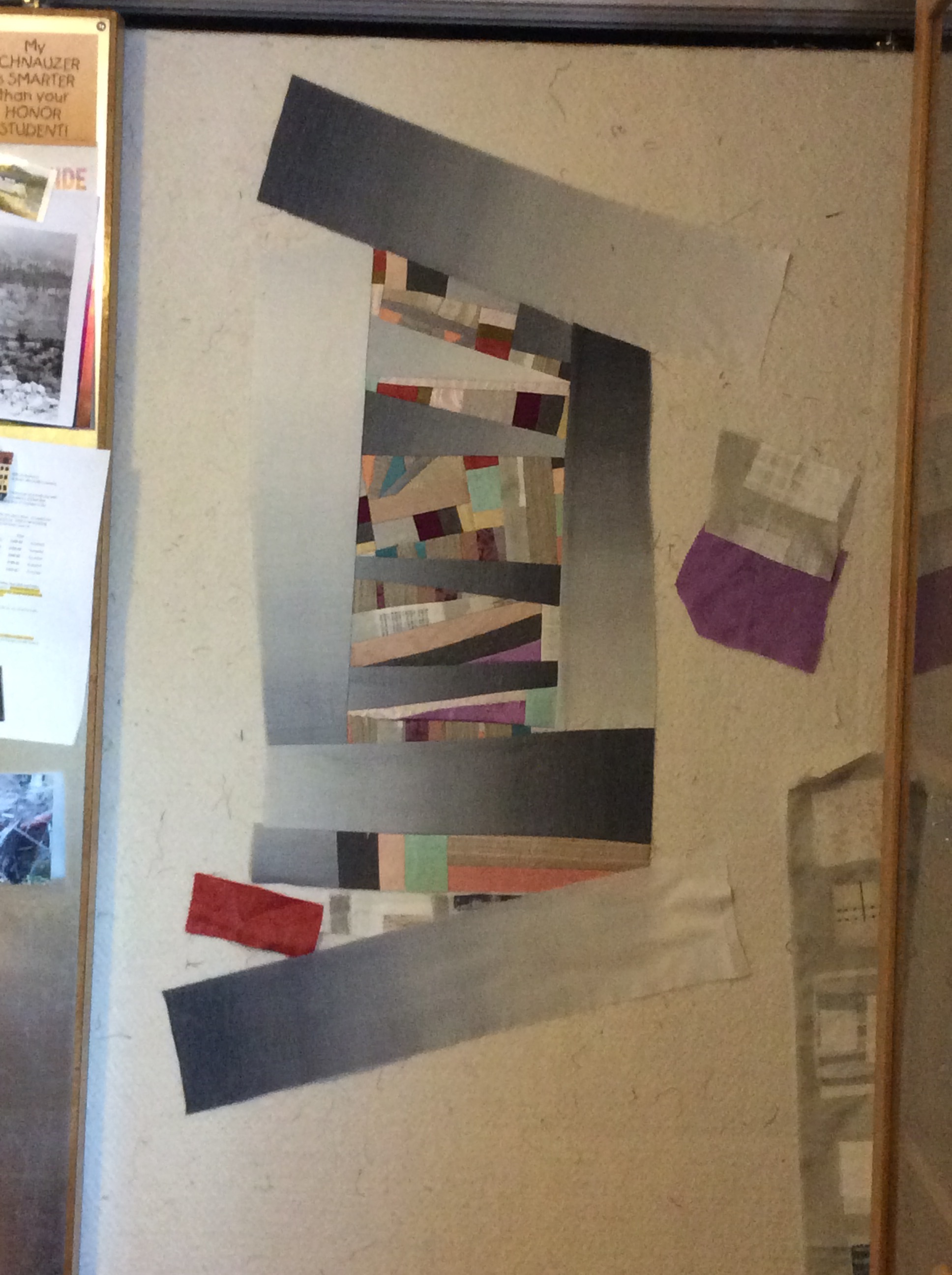
This weekend I worked on a new abstract silk art quilt piece: Abandoned Structure, inspired by a photograph of an abandoned water power plant in Central Oregon.
The water plant is called White River Falls Power Plant and it is located at White River Falls State Park in the Tygh Valley of northern central Oregon. Here is a link to an article, Nature and modern history mix at White River Falls, by station KATU on the history of the hydroelectric dam and powerhouse that was built in 1910 and decommissioned in the 1960s.
Around 6 – 7 years ago, while attending a “Quilt & Cast Retreat” (the wives attend a quilt retreat while the husbands go on a fly fishing day trip) in Maupin, Oregon, we went on a day excursion to White River Falls and I fell in love with abandoned power plant. I took many photos and the photo below inspired the art quilt I am working on:
White River Falls Power Plant
By the way, this post could have also been a continuation of my series on Creative Inspiration, as here is an example where I was inspired by a structure to create an abstract art quilt. Note: I refer to the piece I created as “abstract” as it is not a pictorial recreation of the structure but my interpretation of the feeling I get from the photograph.
Here is the quilt in process on my design wall:
Abandon Structure in progress
I am using recycled garment silks, recycled lines, and some of the Elite Gelato variegated gray fabric I used to carry in my Etsy shop (the bolt ran out except for the 2 yards I kept for my own use).
I will post the completed quilt top on The Wardrobe Meets the Wall blog as it will be part of that collection.
Check out Sassy the highly opinionated miniature schnauzer’s blog on the page Schnauzer Snips for her latest thoughts and adventures.
This is the last of my series of posts on the 4-day quilting retreat I attended last weekend. In my post Getting Ready to “Retreat” I shared photos of the projects I was bringing to the quilting retreat to work on during the retreat.
So one would expect that they would see on my Design Wall a work in progress (or near completion) that I worked on during the retreat – right?
Nope.
What is on my Design Wall is what should not be on my design wall: a quilt I started at the retreat because someone else was working on it and I liked it! This is how new UFOs (unfinished objects) are born!
My Quilt Sister Barb was working on a pattern called Right on Target by A Quilter’s Dream (2013) at the retreat. It involved taking 2 1/2 inch strips from say a pre-cut jelly roll and making a quilt by essentially making one giant log cabin square-in-a-square block. I happened to have a Hoffman Bali Pop on me (a set of 40 pre-cut 2 1/2 inch coordinated batik fabric strips) which was perfect for this pattern. Next thing you know, I had abandoned what I was working on for the afternoon at the retreat and borrowed her pattern and started making the same quilt!
“Right on Target” quilt made by my Quilt Sister Barb at the Retreat
What is on my Design Wall now
Bali Pop of 2 1/2 inch strips pulled apart for quilt
Of course this only reinforces what I discussed in my post Creative Inspiration: What Others are Working On! I know I am not the only quilter to do this – there is something so engaging when you see a quilt in progress that is very appealing and the pattern is very easy!
What became of the projects that I brought to the retreat? Well the two UFOs in boxes (in the photos in the Getting Ready to “Retreat” post) I did not even touch (I guess I brought them as decoration for my assigned work table). Instead I worked on a log jam project (refer to my numerous posts on Log Jamming), started a new project as mentioned above, went on a quilt store shop hop, ate way too much naughty food, and in general goofed off and visited with quilt friends. My kind of retreat weekend!
Check out Sassy’s related post on her blog Schnauzer Snips about her time napping in flannel shirt material Okay, I promise – no more posts about log jamming for a while after this post…maybe. The log jamming continues and now I have a new recruit: If you read the post This is the Story of a Quilting Husband, you read that my husband Terry recently learned to quilt. This past weekend I taught him to log jam (see posts What’s on the Design Wall: “Log Jamming” and “Log Jamming”: The Sequel). On the Design Wall are his first batch of log jamming blocks, made from Flannel Shirt Flannels!*
First set of shirt flannel log jam blocks by Terry, the Quilting Husband
*The shirt flannels were rediscovered during part two of my purge of fabric (see post The Fabric Purge!). This time I worked through my flannels and weeded out those no I no longer needed and rediscovered my tucked away collection of shirt flannels.
No there is not a word missing in the title -.this post is about what is on an actual wall (house wall) not the design wall in my studio (as I normally post on).
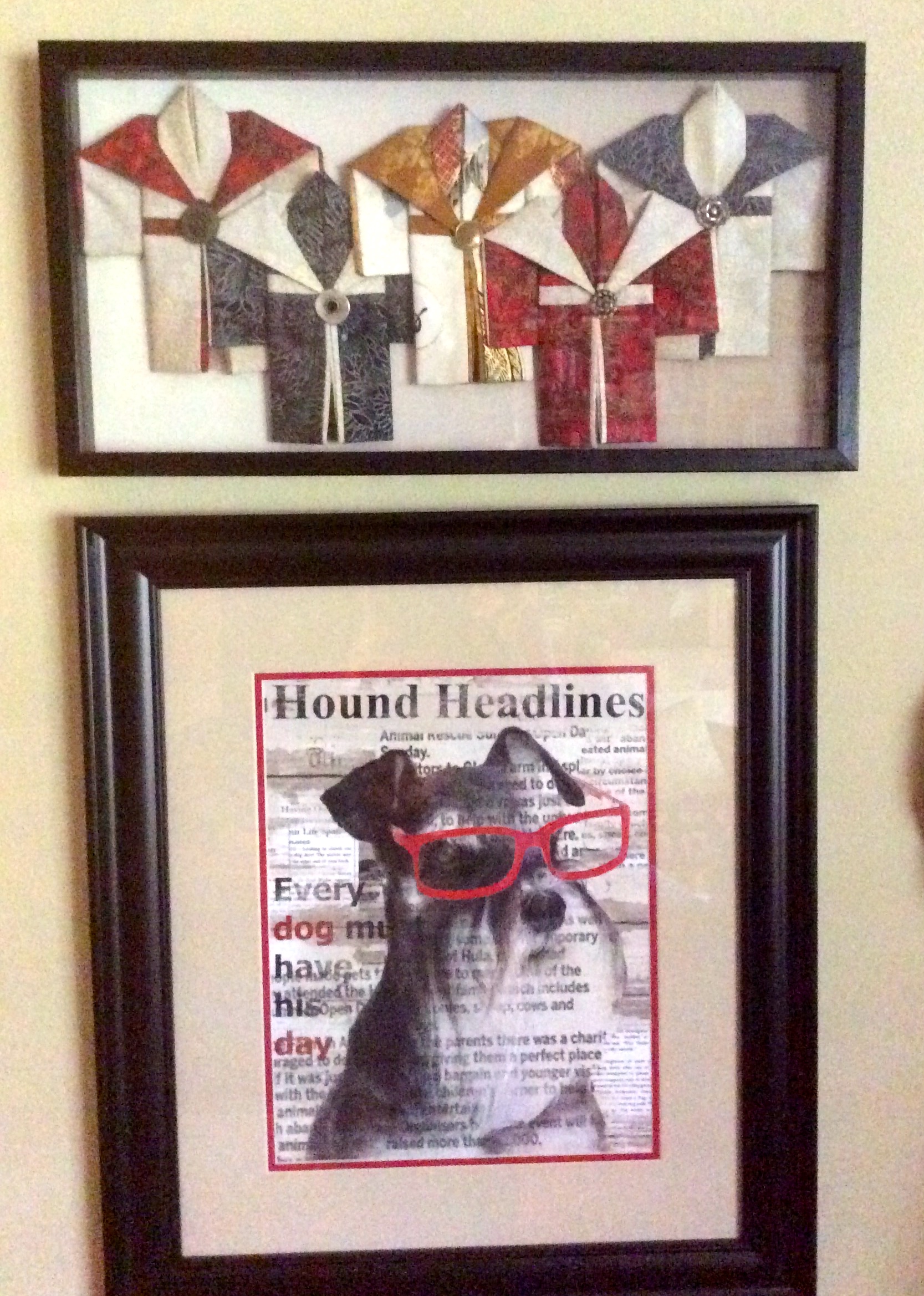
New Wall Art: Miniature Kimono Shadowbox
I have been making miniature kimonos for years – they involve an origami-like folding of fabric to create a kimono shape and measure about 6″ x 7″. Miniature kimonos make great little gifts and I have given them as gifts to friends and family for years. I have also framed a single kimono alone in a shadowbox or in coordinated set of 2-4 kimonos, as gifts.
They were the first items I made for my tierneycreates Etsy shop. Then one day, I abruptly burned out on making them. It has been many months since I thought about making a miniature kimono.
Until the other day: On a whim, I decided to make myself a shadowbox set of kimonos. I chose red, black, cream and gold Asian fabrics to coordinate with a fun schnauzer print I have on the wall where I wanted to hang the kimono wall art.
I made myself a set of 5 miniature kimonosAnother viewAuditioning buttonsFinalized buttomsPreparing the inside of the shadow boxMounting on the shadowbox background with small pins at top and bottom of each kimonoOn the wall in the entryAbove the whimsical schnauzer print
I love making gifts for family and friends as well as items for the Etsy shop, but sometimes you need to just make something for yourself!
Usually I post about what’s on the design wall – what I am currently working on. I was looking through some digital photos and came across photos from when I was working on the 1930’s Block Quilt, made from rescued blocks. So this is sort of a “design wall retrospective” post!
I am fascinated with recycling fabric, especially fabric intended for other purposes (clothing, blankets, upholstery, etc.). I also enjoy finding abandoned blocks and rescuing them!
What are “abandoned blocks”? They are quilt blocks leftover from making a quilt (when too many blocks were made than needed), or when a quilt was started but not finished and the quilter just gave up on the blocks. You can rescue sets of abandoned blocks from thrift stores, friends, and even inside your own stash! Betty Anne had a friend who found a set of block from the 1930s in her attic and did not want them. Betty Anne rescued them and then let me adopt them!
Originally these rescued blocks did not fit together and were in a strange pattern (so strange that no matter what I did I could not make them fit together). So I redesigned the blocks, cutting off the left and right corners (which I recycled into the quilt’s border). After trimming down the blocks they fit well together into a small lap size quilt (41″ x 44 1/2″).
The abandon blocks are now rescued and part of a quilt (I bet they are a lot happier than they would be just sitting around an attic all alone!)
1930’s Block Quilt – pieced by Tierney Davis Hogan, quilted by Betty Anne Guadalupe
Check out Sassy’s page Schnauzer Snips for her latest adventures!
Last Thursday I took the day off from work and participated in a Fabric Surface Design Workshop (actually more like a play day!) through my local SAQA (Studio Art Quilt Associates) chapter. There were four workstations set up for the participants to watch demos on the following surface design techniques:
Fabric printing (using fabric ink and stamps)
Fabric painting (using special fabric paints to achieve a structured or an abstract watercolored-like designs)
Using decolorant to achieve unique surface designs (by removing color from different areas of a fabric in specific patterns)
Mono printing (one time printing using unique found items and special textile techniques)
All the techniques demonstrated were wonderful but I was most drawn to the fabric printing using fabric ink and stamps. The demo involved using manufactured stamps or designing and carving your own. After the demos were complete we had time to play with the new techniques. I ended up carving my own custom stamp with a with a special carving block and a linoleum cutter/carving tool. On SAQA member had a beautiful hand carved tree stamp I fell in love with so I tried to model my hand carved stamped after it.
Below are some photos from my play day! I have an idea already on the piece I am going to design around these printed squares…eventually…
Pre-cuts Wrangling!?!?! What does she mean? Has she been sniffing her fabric glue sticks (normally used for appliqué, not as recreational substances)?
“Pre-cuts” = Those addicting beautifully coordinated collections of pre-cut fabrics in common sizes such as 2 1/1 inch strips, 2 1/2 inch squares, 5 inch squares (aka “charm squares”), 10 inch squares, fat quarter (18 x 22 inch sections of fabric) bundles, and various other tempting configuations.
Wrangling = “To tend or round up” (Dictionary.com)
I have a lot of precuts, more than I need. Likely more than any human needs. I appear to use them to decorate my crafting studio.
Decided to do something crazy – actually USE them instead of just decorate with them!
In my post What’s on the Design Wall: Rediscovering my Charms I discuss delving into my charm pack (5 inch squares) collections and using them to make quilts and wallhangings. Taking a break from charm packs, I have moved to a smaller size of pre-cut – the 2 1/1 inch square pack. I wrangled up my collection of 2 1/2 square pre-cut packs and selected several colorful Rowan/Westminster Fabric packs to create a series of “16 patch” blocks to turn into a quilt. I pieced the 16 patch blocks into a scrappy “postage stamp” style quilt.
I provide some very general simple directions for wrangling your 2 1/2 inch pre-cut packs into a scrappy quilt below the photos.
2 1/2 Pre-Cut Quick Quilt (Wrangle & Design As You Go)
Wrangle a couple packs of 2 1/2 squares (approximately 42 squares in each pre-cut pack) – I think I used 2 or 3 to start
Chain piece non matching pairs of the squares – you will end up with a series of 2 patches
Chain piece the pairs (2 patches) to another set of pairs (2 patches) – you will end up with a series of 4 patches
Chain piece the 4 patches to another 4 patch – you will end up with a series of 8 patches
Chain piece the 8 patches to another 8 patch and finally you will have a series of 16 patch blocks
You can be careful and match your seams, and press between each patch construction or throw caution to the wind and not press until you complete the 16 patch
Sew the 16 patch blocks into rows and then the rows together in to a quilt top
Wrangle and Design As You Go – you might discover you need another 2 1/2 pack to get the size of quilt you want or you might have to save some 8 patches and use them on the side or bottom of the quilt to even out the rows. I used my design wall to decide what block “mathematical configuration” to use. I started with 4 x 7 (4 blocks in a row, 7 rows) but that seemed too narrow. I finally decided on a 5 x 6 quilt (5 blocks in a row, 6 rows of 5 blocks) and will take the row of blocks off the bottom of the design wall, add a couple more and add 1 additional block to each row.
If you are a new quilter or a future quilter and are unfamiliar with how to “chain piece”, check out numerous free online instruction videos available on YouTube or other sources.
A couple of weeks ago I was scheduled to take a quilting class called “Log Jam“. Log Jam is an innovative way to rapidly create scrappy log cabin quilt blocks. If you are a new quilter or not a quilter, a “log cabin” block is a quilting block made by starting with a small center square and building consistent standardly sized strips of fabric around the center square. The log jam concept throws the requirement of consistency sized strips out the window. “Log jamming” makes the log cabin style quilt block construction process laid back, casual, scrappy and fun! When making a log jam quilt you can use a specific palette of scraps, solid colors, or random scraps to make the piece very scrappy.
Unfortunately only three people registered for the class (myself and two of my friends) and it this did not meet the threshold to hold the class. The quilt shop was so wonderful and let us use their classroom anyway and hold our own class (two of my friends had taken the class before). So we spent 6 hours having a blast “log jamming“. The “log jam” method involves the kind of quilt block making you can do while chatting and giggling with friends – it is fun and less structured. We ended up being very silly and singing songs while we were working on our log jams. I even modified Bob Marley’s song “Jamming” to “Log Jamming”!
Now the 27 blocks I made log jamming are sitting on my design wall. I am trying to decide what I want to do with these blocks: maybe a table runner for my series of my Modern Quilt Table Runners on my Etsy shop or maybe one quilt with the blocks set into a solid background or floated. Every quilter should find space for a design wall – it helps to lay your pieces out to see where you want to take them!
If you live in the Central Oregon area, the Stitchin’ Post has a wonderful Log Jam class that my friends and I highly recommend you take!
If you would like to see what is on my design wall in regards to new pieces for The Wardrobe Meets the Wall Collection, check out the post In Progress on The Wardrobe Meets the Wall blog. To stay up to date on Sassy the highly opinionated miniature schnauzer’s check out her page Schnauzer Snips.
CHARM PACKS
If you are quilter you know exactly what I am talking about – those addicting little charm packs. If you are not a quilter – charm packs are collections of precut 5 x 5 in. squares in coordinating fabrics. They are a great way to sample a new fabric collection – they usually come in packs of 40 squares and have at least one of each fabric in a collection. They can also come in solid fabric collections.
I fortunately or unfortunately have acquired quite a stash of charm packs over the years.
You go into a quilt shop and see a new fabric collection and daydream of a yard of each of the new 20 fabrics. Then you remember you need to eat and keep a roof over your head so you don’t give into the temptation of such a glorious shopping spree. Walking away from the collection you were coveting, you spy over in the corner the charm packs sets for the new fabric collection! You now think – “Yes! I can have a taste of the new collection (and still be able to pay my mortgage)!”
You bring them home, with no particular plans in mind for them and put them with the rest of your impulse buy charm packs…
Examples of 5 inch charm packs
A year ago I decided to stop hoarding charm packs and to actually use them. There are many wonderful books with charm pack specific patterns – patterns designed to start with 5 in. squares and go from there. I made a couple quilts from these pattern books, but quickly burned out of this structured traditional quilt making. So I put the rest of the charm packs back in their display (gather dust) area and forgot them.
I was reorganizing my fabric a week ago and came across my stash of charm packs again and thought: Why do I have to use a pattern? Why can’t I just do something initiative and “modern quilting” style? So I took two charm packs of collections of various solid color batik fabrics and randomly sliced each 5 x 5 in. square into three sections. Then I reassembled this huge pile of charm pack sections into random columns. I experimented and sliced up one of the columns to make thinner columns and alternated the columns.
I am still experimenting and plan to create table runners out of these columns. Below are photos of “playtime” on my my design wall.
Experimenting with charm packs
Charm pack table runner in progress
I think they are on their way to becoming quite CHARMING. I am glad I rediscovered my CHARMS!







 tierneycreates