Fabric Scraps Obsession, Studio

“Log Jamming”: The Sequel

This is a followup to my post What’s on the Design Wall: “Log Jamming” :

Last Tuesday evening I took the Log Jam Class at the Stitchin’ Post quilt shop, this time with the actual instructor, Jackie. Jackie is the Queen of the Log Jam (and a wonderful and fun instructor) and I picked up a couple tips I missed when my friends and I made our own class up earlier this year (when our instructor had to cancel so my friends taught me how to “log jam” as discussed in the post What’s on the Design Wall: “Log Jamming” ).

Taking the class again (well taking it for real with the official instructor), got me even more addicted to log jamming. I also learned that the log jamming technique is based on an old African sewing process. I thought it was something the quilt shop had developed, I did not realize it had so much history. Log jamming is such a great way to work through your fabric scrap collection!

So far I have completed 56 – 6 1/2 inch log jam blocks and I have another 30 some in progress. Not sure when I am going to stop working on the blocks and make them into something. Maybe I will just create a huge pile of log jam blocks enough for a couple King-size quilts. But, alas, that will still not put a dent in my fabric scrap collection

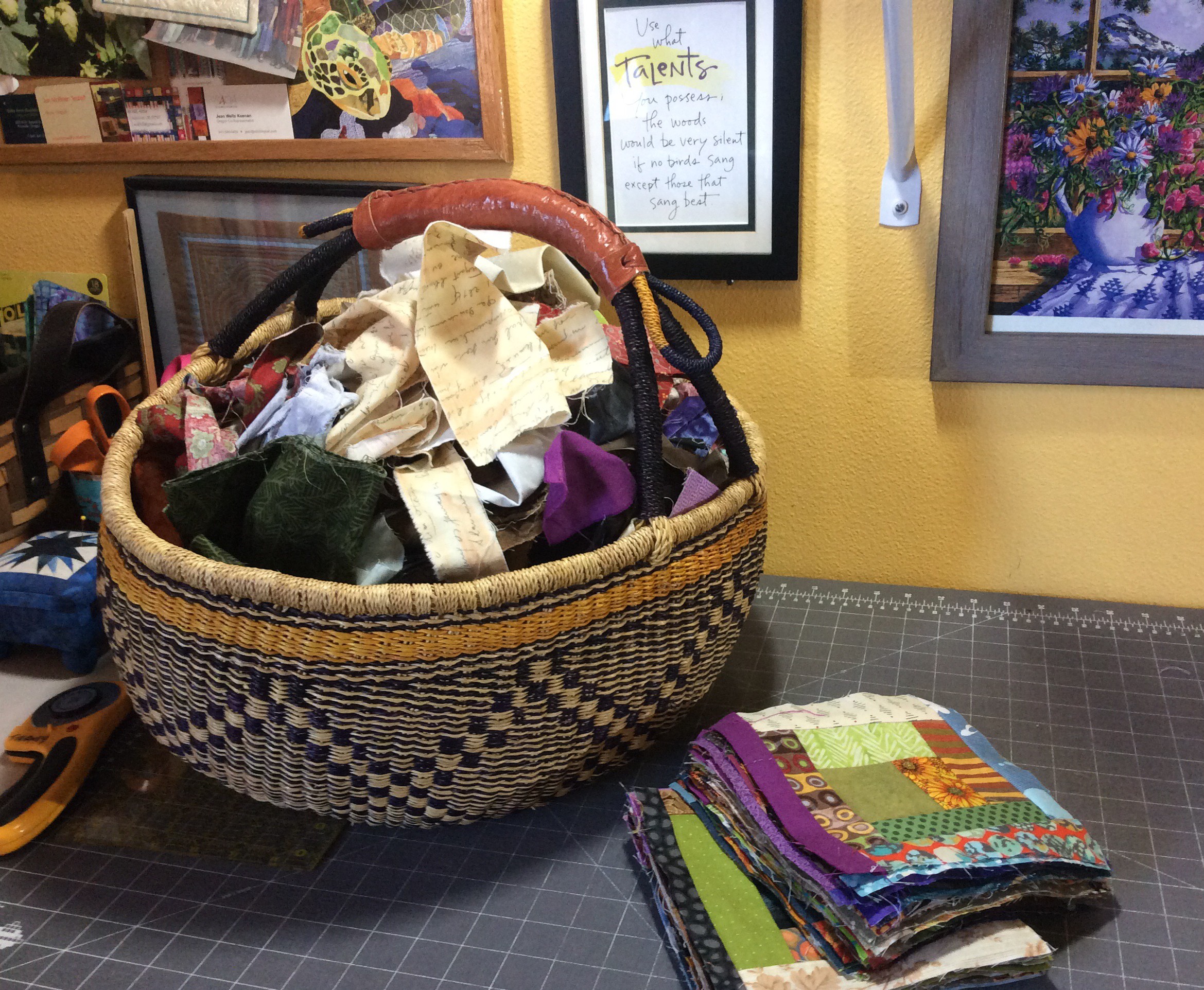
Below is a photo of the basket of coordinating scraps I use while log jamming and my current stack of blocks. My plan is to keep  log jamming with this palette until I exhaust this palette of scraps (or I become exhausted from using the same palette!)

IMG_0378
Basket of scraps for log jamming and stack of completed blocks
Books, Music, Podcasts, My Minimalism Journey, Studio

The Fabric Purge!

Before I talk about my FABRIC PURGE, I wanted to give a little follow up on my Addicted to Audiobooks post:

I had mentioned in the post that one of the disadvantages of free audiobooks from your local library is a short loan period (14 days for example). Recently I discovered that my library allows up to a 21 day audiobook loan period but you have to set up your account that way! I guess when I first set up my digital book account with my library originally I accidentally selected the 14 day hold as my default. I wish I knew this earlier as recently I was in the middle of enjoying Beyond Willpower by Alexander Loyd and my loan expired! The audiobook has other library patron holds on it so I have to wait patiently until my turn comes around again. Ultimately it is my fault for alternating between three audiobooks at once time – 21 day loans will make it even easier (maybe I can alternate between four or five audiobooks…just kidding!)

FABRIC PURGE!

Sometimes you have to let go of clutter to make space for your creativity. I had collected an unwieldy amount of fabric in my 15+ years of being a quilter. My fabric collection (aka “Stash”) includes purchased new fabric, purchased (from thrift shops and garage sales) used fabric, recycled fabrics (old jeans, manufacturing remnants), and fabric given to my by quilting friends.  When I say “fabric” I mean anything from a 1/4 yard to several yards of fabric, not scraps. We won’t talk about my scrap collection at this point…

I had organized all my quilting cotton, non flannel fabrics either by color, by type (Batiks) or by collection in an old IKEA bookcase cabinet. This cabinet was REALLY STUFFED. It was so stuffed that I could not find smaller pieces that have somehow “melted” into the larger pieces. It was time to reevaluate what I really loved and needed in my collection and to let go of that which I do not really love or really need. I had taken Monday and Tuesday off from work for a little “staycation” so I had no excuse not to begin the PURGE!

The purge was kind of painful and tedious. I do not want to discourage anyone from evaluating their clutter and purging, I just want to be honest. I removed all the fabric from the bookcase cabinet and it transformed into a scary mess on the floor. In the spirit of honesty and full disclosure – I did at one point sit on the floor crying and exclaim: “Why do I have this much fabric? I do not need all this!” I had to keep self-coaching to get through the project, reminding myself how wonderful it will be to quickly find the fabric I am looking for and to get rid of what I will never use.

It took two days of sorting through fabric and refolding fabric to complete the project (by the way, I did take many breaks of course and did other things on my “staycation”). I found on Pinterest this wonderful link to instructions on how to uniformly fold your fabric using a ruler so that your fabric will stack easily together: How to Tuesday: Ruler Folding  (from a lovely blog – Create Kids Couture). I organized most of the fabric by color (this time I integrated the Batiks) and some by special collection (one shelf). I purged a giant bag of fabric to give my local quilting friends (oh no I am just adding to their stash so they have to purge someday!)

The fabric purge was worth it, despite some brief emotional distress. I feel like I have made room for my creativity by eliminating clutter!

BEFORE THE PURGE

IMG_0324.2015-04-26_195115

AFTER THE PURGE

IMG_0328.2015-04-27_194415

Studio

A “Charming Quilt”

In my posts What’s on the Design Wall: Rediscovering My “Charms” and What’s on the Design Wall: Pre-cuts Wrangling, I discuss trying to use up my out of control collection of pre-cuts such as charm squares (5 inch pre-cut coordinated squares).

Update: I continue to work through my pre-cuts collection, actually MAKING QUILTS out of them instead of using them to just decorate my studio!

Below is a quilt, “Charming You”, that I created from two packages of charm squares (40-42 squares per package) Moda fabrics.  This quilt measures 45″ x 61″ and has a cozy flannel backing. I just got it back from the long-arm quilter and it is ready to put on the Etsy shop!

Studio, What's on the Design Wall

What’s on the Wall

No there is not a word missing in the title -.this post is about what is on an actual wall (house wall) not the design wall in my studio (as I normally post on).

New Wall Art: Miniature Kimono Shadowbox

I have been making miniature kimonos for years – they involve an origami-like folding of fabric to create a kimono shape and measure about 6″ x 7″. Miniature kimonos make great little gifts and I have given them as gifts to friends and family for years. I have also framed a single kimono alone in a shadowbox or in coordinated set of 2-4 kimonos, as gifts.

They were the first items I made for my tierneycreates Etsy shop. Then one day, I abruptly burned out on making them. It has been many months since I thought about making a miniature kimono.

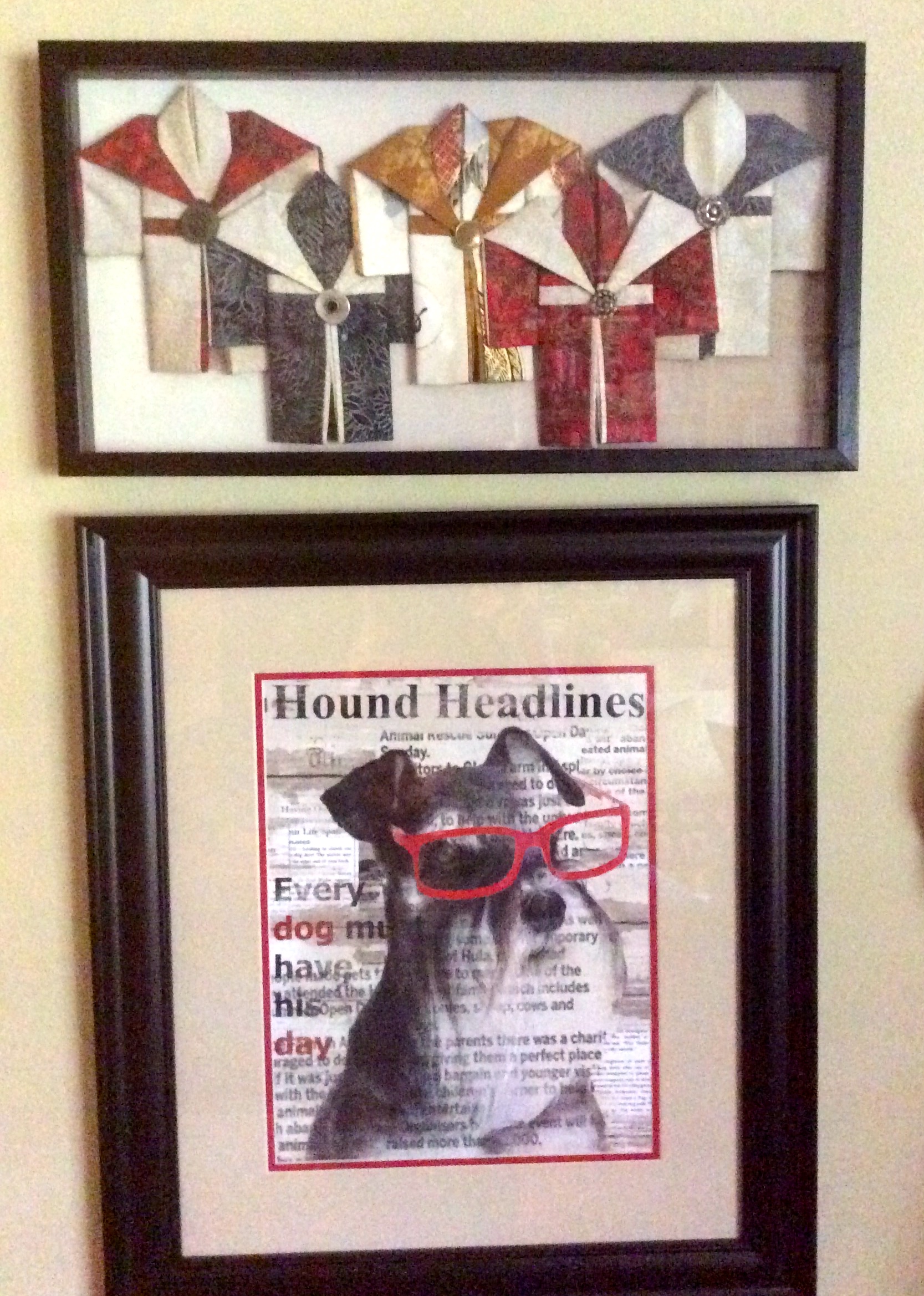
Until the other day: On a whim, I decided to make myself a shadowbox set of kimonos. I chose red, black, cream and gold Asian fabrics to coordinate with a fun schnauzer print I have on the wall where I wanted to hang the kimono wall art.

I made myself a set of 5 miniature kimonos
Another view
Another view
Auditioning buttons
Auditioning buttons
Finalized buttoms
Finalized buttoms
Preparing the inside of the shadow box
Mounting on the shadowbox background with small pins at top and bottom of each kimono
On the wall in the entry
Above the whimsical schnauzer print

I love making gifts for family and friends as well as items for the Etsy shop, but sometimes you need to just make something for yourself!

tierneycreates

Creating Something From Nothing

This post originally appeared on the Improvisational Textiles website on 04/21/2015.

As a member of SAQA (Studio Art Quilt Associates) I receive the SAQA Journal.

In the Spring 2015 edition of the SAQA Journal, an extremely talented textile artists Judy Martin was featured. Her quote in the article “Featured Artist: Judy Martin” summarizes exactly how I view the art quilts I create with discarded textiles.

“Making something slowly with one’s hands is perhaps one of the most nourishing things one can do. Creating something from nothing – or better yet, creating something new from something no longer needed or wanted – is healing for the planet and for us.” –  Judy Martin

In addition to creating art quilts from recycled textiles, I like to create traditional quilts from discarded textiles and discarded blocks.

Please see my post, “What Was On the Design Wall: Rescued Blocks” for an example of a traditional quilt I redesigned  from discarded quilt blocks from the 1930s someone found in their attic.

Studio, What's on the Design Wall

What Was On the Design Wall: Rescued Blocks

Usually I post about what’s on the design wall – what I am currently working on. I was looking through some digital photos and came across photos from when I was working on the 1930’s Block Quilt, made from rescued blocks. So this is sort of a “design wall retrospective” post!

I am fascinated with recycling fabric, especially fabric intended for other purposes (clothing, blankets, upholstery, etc.). I also enjoy finding abandoned blocks and rescuing them!

What are “abandoned blocks”? They are quilt blocks leftover from making a quilt (when too many blocks were made than needed), or when a quilt was started but not finished and the quilter just gave up on the blocks. You can rescue sets of abandoned blocks from thrift stores, friends, and even inside your own stash! Betty Anne had a friend who found a set of block from the 1930s in her attic and did not want them. Betty Anne rescued them and then let me adopt them!

Originally these rescued blocks did not fit together and were in a strange pattern (so strange that no matter what I did I could not make them fit together). So I redesigned the blocks, cutting off the left and right corners (which I recycled into the quilt’s border). After trimming down the blocks they fit well together into a small lap size quilt (41″ x 44 1/2″).

The abandon blocks are now rescued and part of a quilt (I bet they are a lot happier than they would be just sitting around an attic all alone!)

Books, Music, Podcasts

Addicted to Audiobooks

I appear to be addicted to audiobooks – I listen while working on textile crafts, driving, walking, cooking, housecleaning, etc. I know it has truly become an addiction because I am currently listening to three (3) audiobooks at the same time:

  • Better Than Before: Mastering the Habits of Our Everyday Lives by Gretchen Rubin
  • Beyond Willpower by Alexander Loyd
  • Blue Labyrinth by Douglas Preston and Lincoln Child

Alright, I am not actually listening to three (3) audiobooks at once (that would be insane) but I have three different audiobooks loaded on my iPhone and I juggle between the three of them depending on my mood.

It is all the fault of my local library (in true addiction you are supposed to blame someone else, right?) for providing an endless supply of downloadable audiobooks through the Overdrive app. If your library has digital downloads, and you enjoy audiobooks, you should take advantage of this free community resource.

Disadvantages of free audiobooks from the library include only being able to keep them for 14 days (they expire from your device after 14 days) and your library may not have exact book you want. I like the pressure of 14 days though – it makes me actually finish up the audiobook. Usually I have books going at various staggered intervals where one expires in 5 days while the other expires in 11 days.

I have been in the middle of a thrilling audiobook and then boom – it expires – and there are other library patrons who have it on hold so I cannot renew it. I end up having to put the audiobook on hold and wait my turn to finish up my book. But that is okay – it is worth it (and it is free!)

Happy Listening!

Studio, What's on the Design Wall

What’s On the Design Wall: Fabric Surface Design Experimentation

Check out Sassy’s page Schnauzer Snips for her latest adventures!

Last Thursday I took the day off from work and participated in a Fabric Surface Design Workshop (actually more like a play day!) through my local SAQA (Studio Art Quilt Associates) chapter.  There were four workstations set up for the participants to watch demos on the following surface design techniques:

  • Fabric printing (using fabric ink and stamps)
  • Fabric painting (using special fabric paints to achieve a structured or an abstract watercolored-like designs)
  • Using decolorant to achieve unique surface designs (by removing color from different areas of a fabric in specific patterns)
  • Mono printing (one time printing using unique found items and special textile techniques)

All the techniques demonstrated were wonderful but I was most drawn to the fabric printing using fabric ink and stamps. The demo involved using manufactured stamps or designing and carving your own. After the demos were complete we had time to play with the new techniques. I ended up carving my own custom stamp with a with a special carving block and a linoleum cutter/carving tool. On SAQA member had a beautiful hand carved tree stamp I fell in love with so I tried to model my hand carved stamped after it.

Below are some photos from my play day! I have an idea already on the piece I am going to design around these printed squares…eventually…

Books, Music, Podcasts

This is the Story of a Quilting Husband

Check out Sassy the Schnauzer’s latest adventures in her Schnauzer Snips page. 

I recently finished a wonderful audiobook written and read by Ann Patchett: This is the Story of a Happy Marriage (2013) – a brilliant collection of her essays. (Yes, I should just abandon my plan for a year of fictional audiobooks as I continue to primarily listen to nonfiction…)

In Ms. Patchett’s novel she tells, as the title suggests, the story of her happy marriage in one of her essays. I have been fortunate to be happily married for 25+ years to my husband Terry and recently finishing this novel inspired the title of this post.

This is the Story of a Quilting Husband

My husband Terry has always been supportive of my quilting hobby (as he enjoys a nap under a cozy handmade quilt). He never questioned the quilting fabric purchases during my intense “fabric acquisition periods” (refer to the post Craft Book Hoarder?!?!? and substitute “craft book” with “quilting fabric”).

Terry would accompany me to quilt shops and patiently wait while I shopped. Eventually he developed the habit of looking for dog themed fabric (especially if the fabric had schnauzers in it) whenever we went to a quilt shop. This became his special self appointment assignment (which eventually led to a large collection of dog themed fabric in my stash). Occasionally when I was done shopping at the quilt shop, Terry would still be looking around.

Terry became popular among my quilting friends when we lived in Seattle – he drove an Astro Van (which I called the “moving living room”) and he drove several of my quilting friends, myself and our two miniature schnauzers at the time, Fritz and Snickers, all around the Seattle area for Quilt Shop Hop. We must have spent 10 hours that day going to quilt shops and on the road driving a hundred or more miles trying to go to as many quilt shops as possible for shop hop. He deserves a special husband award for doing that!

Last fall I was struggling to make items for my tierneycreates Etsy shop and work my full-time health care job. On a whim I asked Terry: “would you be interested in learning how to quilt and helping me with simple piecing/sewing on quilts and other projects?”  Terry replied, “sure, I can do that.”  He proceeded to “do that”, Terry patiently learned, from his wife, basic sewing machine operation, machine sewing and simple piecing. The plan was to also enroll him in a beginning quilting class but the class he was enrolled got cancelled.

Terry has progressed in his sewing abilities and has become adept at basic straight piecing (sewing a straight edge to another straight edge) and is a natural with the terrifying tool – the rotary cutter (he has never sliced himself like I have). He has helped me on many projects, completing repetitive chain piecing projects and making the binding for my quilts.

His first completed quilt, a yummy log cabin flannel quilt, he gave to his Mom for her birthday as a surprise and she was quite pleased. He finally took his first quilt shop quilting class – on making t-shirt quilt.  Below is a photo of his first t-shirt quilt which made from his collection of brewery and beer enjoyment themed t-shirts.

Luckily I do not see Terry becoming a fabric hoarder like myself, but he does have his own stash (primarily stocked with those dog prints he found over the years). Besides we have a small house and we have reached our limit of fabric!

He is interested in the future in designing quilts that men would enjoy (and women who enjoy simple cozy comfort) made from flannel and denim. His favorite quilt is a quilt I made him in my early days of quilting which is very worn (and not very well constructed, ha) and made from flannel shirt material and denim.

Books, Music, Podcasts, My Minimalism Journey

Craft Book Hoarder?!?!?

Isn’t realization the first step to admitting you might have a problem?

Have you watched the TV show on A&E Network – Hoarders? Well I am not at that level (yet), but I do have some concerns over the size of my craft book collection.  I finally made myself count and I have 370 craft books.

IMG_0144I have crafts book on:

  • Quilting (of course)
  • Knitting
  • Crocheting
  • Beading
  • Pillow making
  • Bag/purse making
  • Potholder making
  • Scrapbooking
  • Organizing your craft space
  • Art inspiration
  • Beading
  • Metal clay
  • Felting
  • Etc.

In addition to craft books, I have quite the collection of crafting related magazines. I refuse to count them. I am still reeling from the shock that I have 370 (or more as I likely under counted) craft books.

So what am I going to do about it? I already gave away all the books I know I will never use to local charity thrift stores (some of the books I originally bought from a charity based thrift store, so I am completing the cycle).

What I would like to do (complete fantasy) is the make at least ONE ITEM from each book and then post it on my blog. That could be 350 new craft projects I would complete (at least 20 books are about organizing and inspiration not the actual making of a craft).

I am going to do it. Maybe. Watch in the future for an ongoing series of blog posts about actually making things from my craft books. Perhaps.  For now, I am seriously going to work on curbing my acquisition of craft books. Definitely.

This post serves as an addendum to the post Living with Less?!?!?! to further support why I would be challenged to scale back to 100 personal items, though I still daydream of living this minimal.

Books, Music, Podcasts, Creative Inspiration

Creative Inspiration: Quiet, Stillness & Daydream

Sometimes quiet, stillness or time out to daydream… to let your mind freely wander…is just what you need to inspire your creativity.

I had committed to a year of listening to fictional audiobooks after listening to a year + of non fiction audiobooks, but I have slipped and a couple non fiction audiobooks have recently graced my ears. Two of those books inspired this post: The Art of Stillness: Adventures in Going Nowhere (2014) by Pico Iyer and The Organized Mind: Thinking Straight in the Age of Information Overload (2014) by Daniel Levitin.

Both of these books explore the need for the mind to be quiet at times. Being still and quiet can open up new windows of creativity.

This is very true for me. When I am stuck on a design for a new fiber piece and it is just not going anywhere, I find that taking a solitary walk or just sitting quietly and daydreaming is what I need to get unstuck.

Daniel Levitin in his book The Organized Mind, explores the importance of allowing your mind to wander freely and daydream. When I was working on the piece Jiko’s Secret Robe (see post A Novel Panel Idea) I was stuck on how to extend the original panel in an interesting way. Giving up on the piece for the evening, I went to bed and let my mind wander and daydream about the piece before going to sleep. Suddenly it came to me:  Mirror the waves in the printed panel and extend the panel with the sensation of flow, movement and waves. When I work up in the morning, I was clear on how to finish the piece.

In Pico Iyer’s audiobook The Art of Stillness, the author shares the story of sitting next to a woman on a plane for a long flight who appeared to be quietly meditating. Later in the flight he spoke to her and she said she was using the long flight to be still and move her mind from work to vacation time. I use stillness to transition from my health care day job to my evening of working on a fiber art quilt piece.

Three Sisters Mountains of the Cascade Mountain range as viewed during an airplane flight

I appreciate a moment of stillness, a pause, in an otherwise overload mind. If we can give our minds a moment to wander freely or just be still we may find it refreshed and energized with new ideas and solutions to creative challenges.

If you would like to see recent piece that came to me during a moment of daydreaming, please see The Wardrobe Meets the Wall’s blog post New Addition to the Collection: Flying Vessel.

Studio, What's on the Design Wall

What’s on the Design Wall: Pre-cuts Wrangling

Pre-cuts Wrangling!?!?! What does she mean? Has she been sniffing her fabric glue sticks (normally used for appliqué, not as recreational substances)?

“Pre-cuts” = Those addicting beautifully coordinated collections of pre-cut fabrics in common sizes such as 2 1/1 inch strips, 2 1/2 inch squares, 5 inch squares (aka “charm squares”), 10 inch squares, fat quarter (18 x 22 inch sections of fabric) bundles, and various other tempting configuations.

Wrangling = “To tend or round up” (Dictionary.com)

I have a lot of precuts, more than I need. Likely more than any human needs. I appear to use them to decorate my crafting studio.

Decided to do something crazy – actually USE them instead of just decorate with them!

In my post What’s on the Design Wall: Rediscovering my Charms I discuss delving into my charm pack (5 inch squares) collections and using them to make quilts and wallhangings. Taking a break from charm packs, I have moved to a smaller size of pre-cut – the 2 1/1 inch square pack. I wrangled up my collection of 2 1/2 square pre-cut packs and selected several colorful Rowan/Westminster Fabric packs to create a series of “16 patch” blocks to turn into a quilt. I pieced the 16 patch blocks into a scrappy “postage stamp” style quilt.

I provide some very general simple directions for wrangling your 2 1/2 inch pre-cut packs into a scrappy quilt below the photos.

 2 1/2 Pre-Cut Quick Quilt (Wrangle & Design As You Go)

  1. Wrangle a couple packs of 2 1/2 squares (approximately 42 squares in each pre-cut pack) – I think I used 2 or 3 to start
  2. Chain piece non matching pairs of the squares – you will end up with a series of 2 patches
  3. Chain piece the pairs (2 patches) to another set of pairs (2 patches) – you will end up with a series of 4 patches
  4. Chain piece the 4 patches to another 4 patch – you will end up with a series of 8 patches
  5. Chain piece the 8 patches to another 8 patch and finally you will have a series of 16 patch blocks
  6. You can be careful and match your seams, and press between each patch construction or throw caution to the wind and not press until you complete the 16 patch
  7. Sew the 16 patch blocks into rows and then the rows together in to a quilt top
  8. Wrangle and Design As You Go – you might discover you need another 2 1/2 pack to get the size of quilt you want or you might have to save some 8 patches and use them on the side or bottom of the quilt to even out the rows. I used my design wall to decide what block “mathematical configuration” to use. I started with 4 x 7 (4 blocks in a row, 7 rows) but that seemed too narrow. I finally decided on a 5 x 6 quilt (5 blocks in a row, 6 rows of 5 blocks) and will take the row of blocks off the bottom of the design wall, add a couple more and add 1 additional block to each row.


If you are a new quilter or a future quilter and are unfamiliar with how to “chain piece”, check out numerous free online instruction videos available on YouTube or other sources. 

Creative Inspiration

Creative Inspiration: What Others Are Working On!

Please check out Sassy’s Schnauzer Snips page for her latest adventures, and check out The Wardrobe Meets the Wall’s post In Progress (Vessel) for photos on my current art quilt project for our collaborative collection. 

Creative Inspiration: What Others Are Working On, continues the series exploring Creative Inspiration that began in the post Creative Inspiration: Family. Other posts in this series include Creative Inspiration: Nature and Creative Inspiration: Fabric.

Winter's Houses (2015). Based on Sandy Bonsib's "House Block", 1998. Pieced by Tierney Davis Hogan, quilted by Betty Anne Guadalupe.
Winter’s Houses (2015). Based on Sandy Bonsib’s “House Block”, 1998. Pieced by Tierney Davis Hogan, quilted by Betty Anne Guadalupe.

If you are a quilter, this may feel familiar: you are at a quilt retreat, or at a quilt class, or you go over to a quilting friend’s house and you see what someone else in working on – and you are suddenly inspired to make something like their piece! 

You have just received creative inspiration from someone else’s piece in progress.

This has happened to me several times. A couple months ago I went over to a friend’s house for a “Sew Day” to each work on our separate projects while hanging out together. I saw what she was working on – these adorable house blocks based on Sandy Bonsib’s 1998 “House Block” (which is easy and fun to assemble, free pattern available online).

I attempt to shy away from traditional quilt blocks but what grabbed my attention (and inspired me to make one too) was the very creative color palette my friend had selected: Orange, Gray and Black.

As you see from the photo – I was inspired to experiment with this color palette and create the same quilt myself. I named the piece Winter’s Houses and used a Moda fabric that reminded me of snow at night as the border. Sometimes someone else is working on exactly what you know you should be working on!

A Crafter's Life, Studio, tierneycreates

Look Look I am in a Book (Part II)

In my posts Look Look I am in a Book  and Oh Wow! I shared my excitement of having several of my quilts selected to be in a book about quilting inspiration called 1000 Quilt Inspirations: Colorful and Creative Designs for Traditional, Modern, and Art Quilts by Sandra Sider. Well the other day my copy of the book arrived in the mail and I was…overwhelmed. Quilt images from 300 artists from 20 countries were selected for this book – and I am one of them!

I am a wanna-be art quilter and I dream someday of “quitting my day job” or at least moving to a part-time version of my health care industry day job and focusing most my energies on tierneycreates and creating. Being in this book feels like a step towards that dream. One of important things I did to advance on this path is to join SAQA (Studio Art Quilt Associates). Through SAQA I found about the call for entries for this book as well as call for entries for other shows I have entered (and been accepted to). I was also very inspired by an article in the SAQA Journal by Carol Ann Waugh on “Becoming a Professional Artist”. I wrote Ms. Waugh to thank her for this incredible article which outlines the steps to become a professional art quilter!

After the initial “intense floating” around the house (and around town on my errands) over seeing sections from five of my quilts in this book in person, I settled back to earth and thought about: “why am I really excited to be in this book?”

I am fortunate to know and interact with several real professional art quilters who have authored their own art quilting and/or traditional quilting books, been in endless shows as well as featured in many books. I greatly admire them and their art, however I realized that is not my goal and not why I was primarily excited about being in this book.

What is most exciting about being in this book is that something that I created might inspire someone else to create. A quilter in Des Moines, Iowa who is looking for color or design inspiration might be leafing through the book and come across my pieces in the book and go – “Aha – that is it!”. What an honor to provide inspiration to someone you never met and will likely never met. I am fortunate to have been inspired by so many talented people I have never met. It is all about sharing our inspiration and hopefully inspiring someone else to take chances, risks and be bold & fearless in their quilt creations!

Below are photos of the quilts that are in the 1000 Quilt Inspirations book. Much thanks to Betty Anne Guadalupe of Guadalupe Designs for her wonderful professional long arm quilting on four of the five quilts that got accepted!

Creative Inspiration

Creative Inspiration: Fabric

A quilter walks into a quilt shop and see fabric. The quilter does not just see fabric, a quilter sees INSPIRATION! In the post “Creative Inspiration: Family” I introduced a series of posts exploring my resources for creative inspiration. This post discusses another important source of my creative inspiration: FABRIC.

Have you ever browsed in a quilt shop and been strongly drawn to a particular bolt of fabric or to an entire collection? You do not have a project in mind for this fabric but you know you just absolutely positively have to have the fabric (or a sample of each fabric from the entire collection) as it inspires you to make something with it (eventually)! However, every quilter knows this is the primary source for an out of control fabric stash, eh?

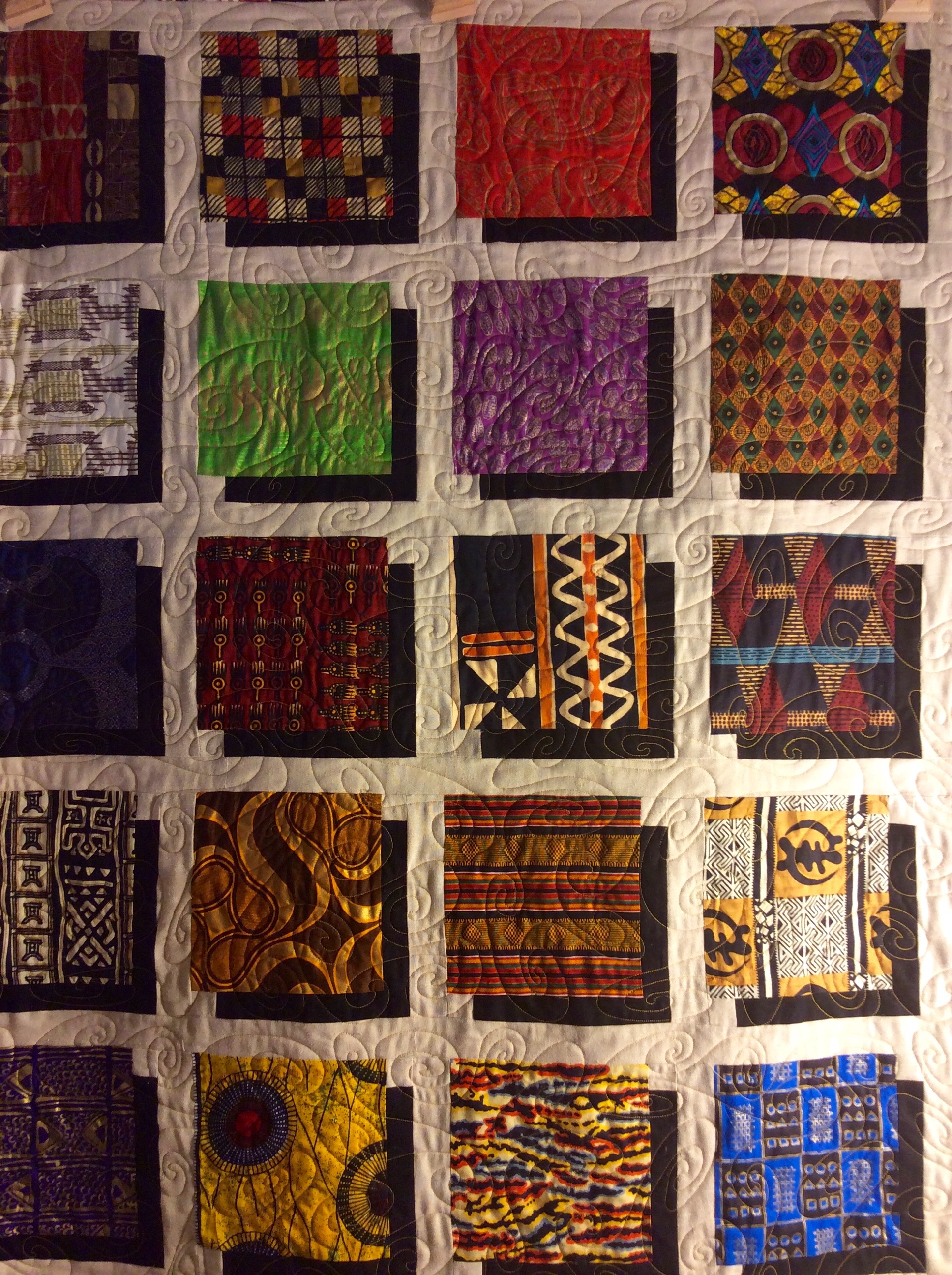
Fabric/Textiles are a major source of creative inspiration for me. When I find interesting and unique fabrics they inspire me to create something that honors their beauty. Last year I was fortunate enough to be given a small collection of African textiles from someone’s estate. I was overwhelmed with the richness and colors in these textiles. This inspired me to create a piece, called African Windows, to showcase these fabrics. I used a basic “attic windows” pattern concept where shadows are created by piecing a darker solid fabric (in this case black fabric) strategically to create the illusion of a window.

Below are photos of my quilt African Windows (2014) which was long arm quilted by Betty Anne Guadalupe of Guadalupe Designs.

African Windows (2014). Pieced by Tierney Davis Hogan, quilted by Betty Anne Guadalupe.
Fabric Scraps Obsession, Studio, What's on the Design Wall

What’s on the Design Wall: “Log Jamming”

A couple of weeks ago I was scheduled to take a quilting class called “Log Jam“. Log Jam is an innovative way to rapidly create scrappy log cabin quilt blocks. If you are a new quilter or not a quilter, a “log cabin” block is a quilting block made by starting with a small center square and building consistent standardly sized strips of fabric around the center square. The log jam concept throws the requirement of consistency sized strips out the window. “Log jamming” makes the log cabin style quilt block construction process laid back, casual, scrappy and fun! When making a log jam quilt you can use a specific palette of scraps, solid colors, or random scraps to make the piece very scrappy.

Unfortunately only three people registered for the class (myself and two of my friends) and it this did not meet the threshold to hold the class. The quilt shop was so wonderful and let us use their classroom anyway and hold our own class (two of my friends had taken the class before). So we spent 6 hours having a blast “log jamming“. The “log jam” method involves the kind of quilt block making you can do while chatting and giggling with friends – it is fun and less structured. We ended up being very silly and singing songs while we were working on our log jams. I even modified Bob Marley’s song “Jamming” to “Log Jamming”!

Now the 27 blocks I made log jamming are sitting on my design wall. I am trying to decide what I want to do with these blocks: maybe a table runner for my series of my Modern Quilt Table Runners on my Etsy shop or maybe one quilt with the blocks set into a solid background or floated. Every quilter should find space for a design wall – it helps to lay your pieces out to see where you want to take them!

If you live in the Central Oregon area, the Stitchin’ Post has a wonderful Log Jam class that my friends and I highly recommend you take!

Creative Inspiration

Creative Inspiration: Nature

In the post “Creative Inspiration: Family” I introduced a series of posts exploring my resources for creative inspiration. This post discusses another important source of creative inspiration for me: Nature.

There is so much beauty around us. Whether you live in beautiful Central Oregon like I do or whether you live in a busy urban environment. You just have to stop for a moment and look around. A solitary tree on a city block can be a wonderful source of nature based inspiration for your creativity as well as a panoramic vista in a national park.

Jean Wells in her inspirational books Intuitive Color & Design: Adventures in Art Quilting (C&T Publishing, 2009)  and Journey to Inspired Art Quilting: More Intuitive Color & Design (C&T Publishing, 2012), explores in depth how nature and the environment around you can be a significant resource for creative inspiration. I will talk more about Jean Wells and her influence on my creative inspiration in a future blog post on “Creative Inspiration: Mentors”. Check out Jean Well’s publications for inspirational ideas on your fiber art or just walk around and really see the beauty and inspiration around you!

To demonstrate Nature’s Inspiration, below are photos from a wonderful trip with a friend to Red Rock Canyon State Park a couple years ago. I used the colors in the photos from this trip to inspire a batik art quilt I made.

 “Nature does not hurry, yet everything is accomplished.”

~Lao Tzu

Creative Inspiration

Creative Inspiration: Family

A friend commented to me: “I thought your blog was just about quilting…”

If you have been following my blog you have figured out it is more than a discussion of quilting techniques and ideas. I enjoy writing about the creative process which includes the audiobooks I listen to while creating, food I enjoy when taking a break from creating (so I can be adequately nourished to continue creating), organizing the space in which I create and some general life topics that some how tie into creating. Of course I do throw in a couple quilting specific posts here and there!

This post begins a series on a topic I want to explore: Creative Inspiration. I will share some of my major sources of creative inspiration and if you are a creative person I would love hear about your sources of inspiration in the Comments.

My number one source of Inspiration is my immediate family which include my sister, brother, and parents (both deceased) as well as my husband. This post relates to inspiration from my biologic family and I will discuss inspiration from my wonderful husband in another post.

SISTER

My younger sister is an amazing woman and mother. She is a very creative person. She has been a major source of inspiration as it was her reaction to the second quilt I ever made (which I sent to her as a surprise) that inspired me to embrace quilting as a hobby. I have made her and her family numerous quilts over the years and they keep them until they are complete worn and threadbare and treat each one like a precious possession. How could one not be inspired to keep quilting? She was also the one who encouraged me to “get off my butt” and pursue my dream of starting tierneycreates. She worked with me on specific tasks, goals and timelines. She helped move tierneycreates from a daydream to a reality. She continues to cheerlead and be a pivotal source of inspiration.

BROTHER

My younger brother is an amazing man and father. While he was in undergraduate study he knew he wanted to be in business for himself and by the time he was in graduate school he had successfully started his entrepreneurial career. As a young man he told me “I just do not want to work for someone else, I do not want to spend my life as an employee”. He has such vision and drive that he has propelled himself toward the life that he wanted, despite and roadblocks or struggles. His entrepreneurial creativity example also inspired me to start tierneycreates. I do not see me leaving my “day job” in health care anytime soon but it is exciting to experience some of what he experiences as an entrepreneur.

MOTHER

My mother was a very creative woman and used to teach drama. She loved color and enjoyed interior decorating. I remember as a child we had many themed rooms in our house all uniquely decorated. She passed when I was in my 20s from breast cancer. I think I inherited her flair for color and design.

FATHER

My father (who passed in 2008) is my greatest source of inspiration. He was an educator, social worker, civil rights activist and community leader. Growing up in the 1970s where not a lot of African American history was taught in schools, my father thought it was important that I learn specifically about great African American innovators, inventors, activists and leaders. From a young age this inspired me to take risks despite adversity. My father grew up in the segregated South during the 1930s -1940s and he was involved in the Civil Rights Movement of the late 1950s and 1960s (he even met Martin Luther King, Jr. and other great Civil Rights leaders). Despite his experiences with great adversity and segregation he taught us to always treat everyone equally and never to think anyone is less than you because they are different from you. People are just people. He inspired my openness to new experiences, new people and new ideas, which I think is important in the creative process and defined the core of who I am as a person.

My father shared many inspiring stories with us from growing up in the South during a difficult time for minorities, here is one of them:

In the late 1940s I got on a bus and sat near a man who called me a (racial slur) and loudly said “I don’t like you, (racial slur)”. I calmly responded “but if you got to know me, you would like me.” This relaxed the tension and opened friendly dialogue. At the end of the bus ride we shook hands and pleasantly parted ways. – Raoul Davis, Sr.

Strawberry Fields - Central Park’s Memorial to John Lennon, taken 2008 during my trip to NYC.
Strawberry Fields – Central Park’s Memorial to John Lennon, taken 2008 during a family trip to NYC.

What are your sources of inspiration? 

Quality of Life, Quilt Retreats

Retreating is not necessarily “retreating”

I am honored to be invited to teach a hand piecing/quilting/spiritual art class at the Women’s Relaxation Reiki Retreat in Finland, August 19-22, 2016 and I am working on developing Northern Lights (aka the aurora borealis) themed project options for the class since the Northern Lights will be in view during the retreat.

This will be a working retreat for me where I get to attend some classes and teach a couple of classes. I started thinking about the whole idea of going on a retreat/retreating and Quilting Retreats I have attended in the past (and those planned with my quilting friends in the near future) and this post shares my thoughts.

If you look up the word retreat in a dictionary you made find definitions like these below:

  • movement by soldiers away from an enemy because the enemy is winning or has won a battle
  • movement away from a place or situation especially because it is dangerous, unpleasant, etc.
  • the act of changing your opinion or position on something because it is unpopular

(Source – http://www.merriam-webster.com)

None of these definitions have anything to do with the type of retreats I enjoy! To retreat is commonly thought of as backing away and/or pulling into yourself. There are retreats such as spiritual based and meditation retreats where the purpose is to back away from your daily life and worries and to pull into yourself to gain perspective or spiritual enlightenment.  I admire people who attend these type of purely inward focused retreats. However the type of retreats enjoy involve connecting with people.

I am so fortunate to have a wonderful group of quilting friends from various parts of the country. I met these women through quilting retreats and because we deeply connected, we continue to retreat together year after year. We even plan our own special group retreat where only our private group attends. Yes, I will admit it – sometimes I bring a couple projects to these retreats and do not get much quilt piecing done. However what are you going to most remember about a quilt retreat: 1) that you completed 5 projects; or 2) that you hung out with some amazing women and had many laughs?

It is magical to connect with a stranger at a retreat on other common ground beyond being a quilter. I am originally from New York and I have bonded with another quilter because she is also “a Yankee”.

If you are a quilter/crafter, I bet you could not imagine attending a quilting/crafting retreat in which you just “back away/pull into yourself”. I have met a couple people at quilting retreats who just wanted to focus on their projects and were not very social – however I am not sure they had as great a time as those that did not get as much done but had a blast connecting with other retreat attendees.

Besides connecting with fun people, the other wonderful parts of quilt retreating are a scenic peaceful location (I do love a retreat where you can go for a solitary walk in a pastoral location and take break from the group setting), impromptu outings to local quilt shops (with old or new quilt friends), and yummy food to enjoy (that I did not have to cook!)

“Happiness [is] only real when shared” – Jon Krakauer, Into the Wild

Studio

A Novel Panel Idea

Our library has a community wide book club book once a year called A Novel Idea. In the fall, our library unveils the selected novel and everyone in the community is encouraged to read the book. In spring the book’s author is invite to town to speak for the ultimate book club meeting. As part of the Novel Idea celebration in the spring the library has an art show to feature art inspired by the community read novel.

I read the book, A Tale for the Time Being by Ruth Ozeki as soon as it was announced as the selected book and loved it. I was determined to enter the art show and create a piece of fiber art inspired by this wonderful novel.

But where to start…

I have a collection of pre-printed fabric panels that I have collected over the years. Some panels in the collection, that I bought long ago, I look at and go “what was I thinking?” Others I look at and think: “what am I going to do with that?” Some quilters look down on using panels and think they are cheating because you are not piecing the entire piece.

Remembered in my collection of panels I had a lovely kimono panel printed with images of the sea and sky – that seemed like the right place to start as part of the novel took place in Japan. I mirrored the palette of the panel to create a flowing extension of the panel’s scene.

Here are photos” from my design wall to completed piece just hung in the downtown branch of our library for the upcoming show

On the back of the finished piece I put a label about my inspiration:

Jiko’s Secret Robe (2015)

Quilt inspired by Ruth Ozeki’s novel A Tale for the Time Being: Nao’s great grandmother, Jiko, is a humble and wise 100+ year-old Buddhist nun who wears simple robes and lives a simple life. This quilt represents Jiko’s secret robe – a robe not visible to the eye but visible to the soul – representing the complexity and depths of Jiko’s spirit, experience, wisdom and compassion for all beings and the earth.

“For the time being, the entire earth and the boundless sky.”– Ruth Ozeki

Studio, What's on the Design Wall

What’s on the Design Wall: Rediscovering My “Charms”

If you would like to see what is on my design wall in regards to new pieces for The Wardrobe Meets the Wall Collection, check out the post In Progress on The Wardrobe Meets the Wall blog.  To stay up to date on Sassy the highly opinionated miniature schnauzer’s check out her page Schnauzer Snips

CHARM PACKS

If you are quilter you know exactly what I am talking about – those addicting little charm packs. If you are not a quilter – charm packs are collections of precut 5 x 5 in. squares in coordinating fabrics. They are a great way to sample a new fabric collection – they usually come in packs of 40 squares and have at least one of each fabric in a collection. They can also come in solid fabric collections.

I fortunately or unfortunately have acquired quite a stash of charm packs over the years.

You go into a quilt shop and see a new fabric collection and daydream of a yard of each of the new 20 fabrics. Then you remember you need to eat and keep a roof over your head so you don’t give into the temptation of such a glorious shopping spree. Walking away from the collection you were coveting, you spy over in the corner the charm packs sets for the new fabric collection! You now think – “Yes! I can have a taste of the new collection (and still be able to pay my mortgage)!”

You bring them home, with no particular plans in mind for them and put them with the rest of your impulse buy charm packs…

Examples of 5 inch charm packs

A year ago I decided to stop hoarding charm packs and to actually use them. There are many wonderful books with charm pack specific patterns – patterns designed to start with 5 in. squares and go from there.  I made a couple quilts from these pattern books, but quickly burned out of this structured traditional quilt making. So I put the rest of the charm packs back in their display (gather dust) area and forgot them.

I was reorganizing my fabric a week ago and came across my stash of charm packs again and thought: Why do I have to use a pattern? Why can’t I just do something initiative and “modern quilting” style? So I took two charm packs of collections of various solid color batik fabrics and randomly sliced each 5 x 5 in. square into three sections. Then I reassembled this huge pile of charm pack sections into random columns. I experimented and sliced up one of the columns to make thinner columns and alternated the columns.

I am still experimenting and plan to create table runners out of these columns. Below are photos of “playtime” on my my design wall.

I think they are on their way to becoming quite CHARMING. I am glad I rediscovered my CHARMS!

My Minimalism Journey, Quality of Life

Living with Less?!?!?!

A favorite pastime is to browse the library shelves for crafting and home design/decorating books. During a browse the other day I found a book Living with Less: how to downsize to 100 personal possession by Mary Lambert (2013).

I am really into the “Tiny House” movement and I am known to blow a weekend afternoon looking at “Tiny House Porn” on YouTube. I love the idea of scaling back and scaling down your life and “living with less” in exchange for quality of life. Ms. Lambert’s book provides an excellent process on scaling back your life to 100 personal possessions.  In exchange for this downsizing you can gain an “ordered life” and  “liberate your mind, body, an spirit”. After reading 1/2 of the book and skimming the other half – I was sold on this wonderful concept.

Until a casual conversation with my husband…

My husband Terry has been very tolerant of my obsession with tiny houses and scaling back our lives. We already live in a 1300 square foot house (having scaled back 9 years ago from a 2800 sq. ft house) and we have a fairly simple and thrifty lifestyle. Still I fantasize about being able to “quit my day job” in health care and dedicate myself full-time to tierneycreates.

Terry, the Realist, quietly nods his head while I give him an enthusiast summary of the book Living with Less and idea of each of us pairing down to 100 possessions. Terry gets up from his chair and begins to start counting out loud the quilts hanging on the wall, hanging on the quit rack, on beds and chairs, and then in a cabinet. He states: “do these all count as one item or 25?” Then he begins to count the craft books I have on the shelf, and I tell him to stop (as I do have an issue with craft books).

He sighs and states: “So will you just be keeping a pair of underwear, a pair of socks, a pair of shoes, and 1 outfit in your scaling down?  And, do all those fat quarters of fabric count as one piece of fabric?”

So, as much as I admire Ms. Lambert’s concept of scaling down I do not think it can happen anytime soon.

My pile of scraps for making scrap quilts: Do they each count as 1 item or can I group all the scraps together as one item?


Books, Music, Podcasts

Life is Nonfiction: Part V

We arrive at the conclusion of a series of posts which began with Life is Nonfiction, a listing  of my favorite nonfiction audiobooks and subsequent discussion of key insights I gained from listening to these books.

In my prior post in this series, Life is Nonfiction: Part IV, I opened with a brief discussion of  the fictional audiobooks I have listened to recently as part of my 2015 “a year of fiction”. I realized forgot to mention that I had recently finished the Ann Patchett’s book The Magician’s Assistant, a highly enjoyable listen about being in love with someone you cannot have, closure, and finding your own way. Currently I am listening to Ann Patchett’s The Story of a Happy Marriage, an excellent collection of her essays. After reading or listening to Bel Canto, State of Wonder, The Magician’s Assistant and now The Story of a Happy Marriage, I have decided to start with her earliest novel, The Patron Saint of Liars and read/listen to her entire catalogue of novels. I have become interested in exploring an author’s entire body of work. It is intriguing to find reoccurring themes in an author’s writing. So far several of Ann Patchett’s novels touch upon some version of unrequited love.

Now onto the key insights I gained from the remaining favorite nonfiction audiobooks:

Robinson, Ken (2013). Finding your element: how to discover your talents and passions and transform your lifeNew York, NY: Viking.

KEY INSIGHT: Be brave and identify where your passions lie. The pursue them!

Singer, Michael (2013). The untethered soul: the journey beyond yourself. Oakland, CA: New Harbinger Publications.

KEY INSIGHT: I think this book is a mandatory read for humans. I first read it and then I listened to the audiobook. The audiobook is humorous in a way, after reading this very profound book, as the narrator sounds like a slightly irritated New Yorker telling you to “get over yourself”. The key insight of the book is basically “get over yourself”! Don’t listen to your ego talking and bossing you around, find your real voice, the voice at your core. This book helps you dispel with the negative self-talk and “chatter” and get to the magic and the beauty of being a conscious living being. I must recommend that for your first exposure to this book – read the book and then if you want to revisit it listen to the “slightly irritated New Yorker” narration!

Taleb, Nassim (2012). Antifragile: things that gain from disorder. New York, NY: Random House.

KEY INSIGHT: Awareness of the fragility in systems, what makes them fragile, and how to protect yourself professionally and personally.

Tolle, Eckhart (2005). A new earth: awakening to your life’s purpose. New York, NY: Dutton/Penguin Group.

KEY INSIGHT: Like the book The untethered soul, this book focuses on the awareness of the ego and then letting go of the ego. Listening to this book helped me gain quite a sense of peace and release from things that I was obsessing and worrying about as ultimately many of them do not matter in the whole scheme of the universe.

Tolle, Eckhart (1999), The power of now: a guide to spiritual enlightenment. Novato, CA: New World Library.

KEY INSIGHT: Live in the moment. The past is not changeable and the future is not ultimately known. This book helped me let go of many worries and to appreciate what I am experiencing in the moment. This book is about being fully present in the Present.

Weber, Lauren (2009). In cheap we trust: the story of a misunderstood American virtueNew York, NY: Little, Brown.

KEY INSIGHT: This book was an enjoyable discussion on the history of frugality and that “being cheap” is not a bad thing!

White, Jennifer (2004). Work less, make more. Ashland, OR: Blackstone Audiobooks.

KEY INSIGHT: This book encouraged intense scrutiny of what was really important to me in life. I realized that my health care career was not at the top of the list. At the top of the list is family (including furry family members) and my tierneycreates creations!

Whew – not sure what I was thinking when I decided to take on discussion/key insights of so many nonfiction audiobooks. I hope you will find a book or two that inspire you after all these insights. I did notice repetition in “self-help” nonfiction audiobooks but repetition of important ideas/concepts can be a good thing. Happy Listening!

Studio

Rethinking a Closet

I am addicted to “Studio Porn” – photos of artists’ and crafters’ studios. At least once a week I settle in with a cup of tea, in a cozy chair, and leaf through publications such as Studios and Where Women Create or various books on craft/art studio organization. These publications are filled inspirations on how to organize, design, and decorate your studio.

My studio is small, but I feel lucky to have a place in my home that I can dedicate to my crafting. It was designed as a bedroom and I removed the traditional bifold closet doors to open the space to organize and store supplies. I thought: “who needs closet doors when you can have more open space?”

Then I saw the studio of Jean Wells in the Better Homes and Gardens book Studio Spaces: Projects, Inspiration & Ideas for Your Creative Place (2011) and I saw what a closet can be in a studio! Ms. Wells turned one side of a closet door into an inspiration board and the other into a design wall. Her closet doors became my dream closet doors! Thanks to a generous gift from my mother-in-law, my dream studio closet doors have become a reality!

Cindi and Rob of CR Construction did an excellent job designing my new closet doors based on the photos from the book. They put sheet metal on the left door and wrapped Warm & Natural cotton batting on the right door. They designed a unique floating track system that allowed the doors to float over each other without touching when opened. This allows pieces on the design wall side not to be disturbed (who wants to redo their design wall every time they open their closet?). Cindi and Rob added strong bright lighting inside the closet – previously I had no light and would aim a lamp in the studio towards the closet to illuminate it in the evening.

My home studio is very simple and a mishmash of furniture and shelves thrown together, but my closet feels really special and inspires my creativity!

Check out the Textiles Adventures page for other updates.

Books, Music, Podcasts

Life is Nonfiction: Part IV

After spending last couple years primarily listening to Nonfiction audiobooks, 2015 continues to be an enjoyable year of Fiction audiobooks as I focus my audiobook selections to fictional stories. So far all have been excellent. After listening to Ruth Ozeki’s A Tale for the Time Being, I delved into Margaret Atwood’s impressive collection of short stories – Stone Mattress: Nine Tales. The book was narrated by the author herself as well as several other wonderful narrators. Several of the short stories are connected in a masterful way and others stand alone. Many deal with themes about aging and empowerment in the face of loss of youth, while others are just marvelous little fantasy stories. After finishing Stone Mattress, I listened to Rene Denfeld’s mind blowing novel The Enchanted: A Novel that provided a lyrical story about life on death row from the perspective of an incarcerated  sociopath with profound mental illness. It does not sound like something appealing to listen to but the narration by Jim Frangione is amazing as is the extremely masterful story.

Now you are thinking: “Wait a minute Tierney, the title of this post is Life is Nonfiction: Part IV!”  You are right and the actual purpose of this post is to continue sharing the key insights from the list of my favorite nonfiction audiobooks which I began in the post Life is Nonfiction.

So here we go:

Guillebeau, Chris (2010). The art of nonconformity: Set your own rules, live the life you want, and change the world. New York, NY: Penguin Group.

KEY INSIGHT: To live life on your own terms; and that it is okay to give yourself permission do that! I have always felt like I never quite “fit in” and have always considered myself an outsider. This book reinforced it is okay to be an “outsider” and to walk your own unique path. The more I listen to books like this more I am at peace with being an outsider and walking my own path.

Heath, Chip (2013). Decisive: how to make better choices in life and work. New York, NY: Crown Business.

KEY INSIGHT: This audiobook provided great insights on making better choices personally and professionally. I loved the “WRAP” method of decision making discussed in the book: 1) Widen your choices; 2) Reality test your assumptions; 3) Attain distance before deciding; and 4) Prepare to be wrong.

Heath Chip & Health, Dan (2010). Switch: how to change things when when is hard. New York, NY: Books on Tape.

KEY INSIGHT: Looki at change in an optimistic way and honestly examine obstacles to change.

Huffington, Arianna (2014). Thrive: the third metric to redefining success and creating a life of well-being, wisdom, and wonder. New York, NY: Random House.

KEY INSIGHT: This is one of the best nonfiction audiobooks ever in my opinion. The female narrator has a Greek accent to give you the feel that  A. Huffington (of The Huffington Post) herself is reading the book to you. This book inspires one to rethink, or think about for the first time what success really means to you personally and professionally. This audiobook inspires you to examine what is actually important in your life. This audiobook importantly encourages you to take care of yourself in a loving manner and to protect yourself from burnout. This audiobook inspired me to get more sleep, which has been a wonderful thing (and has made our miniature schnauzer Sassy very happy as she loves to go to bed as early as possible if you read her blog on Schnauzer Snips).

Kelly, Matthew (2011). Off balance: getting beyond the work-life balance mouth to personal and professional satisfactionAshland, OR: Blackstone Audio.

KEY INSIGHT: That work-life balance is a myth! This audiobook inspired me to look beyond that myth and honestly examine where I want to focus my energies in life.

Kingsolver, Barbara (2007). Animal, vegetable, miracle: a year of food life. New York: Harper Collins Publishers.

KEY INSIGHT: In this wonderful book narrated by the author, Barbara Kingsolver takes the reader along with her family’s one year experiment of growing and raising their own food. She shares all the hurdles and challenges to eat “clean” and local in humorous, educational and poignant ways. After reading Fast Food Nation and The Omnivore’s Dilemma years ago I was already conscious about “where does the food I eat actually come from and how it is processed?” This book helped remind me to make wise choices on what food I bring in my house/place on my table/put in my mouth.

Kornfield, Jack & Siegel, Daniel (2011). Mindfulness and the brain. Louisville, KY: Sounds True.

KEY INSIGHT: Why slowing down and being mindful is so important to your mental health. After listening to this audiobook I began to believe in the power of meditation.

McKeown, Greg (2014). Essentialism: the disciplined pursuit of less. New York: Crown Business.

KEY INSIGHT: I already knew you do not need a lot of stuff or achievements to be happy but this audiobook beautifully reinforced this concept. This audiobook made me think about living my life more simply and carefully deciding where I want to put my time and energy.

I hope you experience some of these excellent nonfiction audiobooks for yourself.

.